Pre-order ‘Long Road to Nowhere: The Lost Years of Richard Trevithick (Part One)’ now, HERE.
The following day I returned to the cemeteries in the hope the first one at least would be open. On the way there I spotted a sign hanging over the street that looked suspiciously like a Cornish flag bearing the name ‘Consulta Medica Sermeda’ a medical clinic that specialised in obesity. It definitely wasn’t a red cross; it was a white cross with a black background, very Cornish, but clearly very un-Cornish at the same time. I would have stepped inside to marvel at the hefty maids, but every time I walked past the shutters were down, seemingly forever.
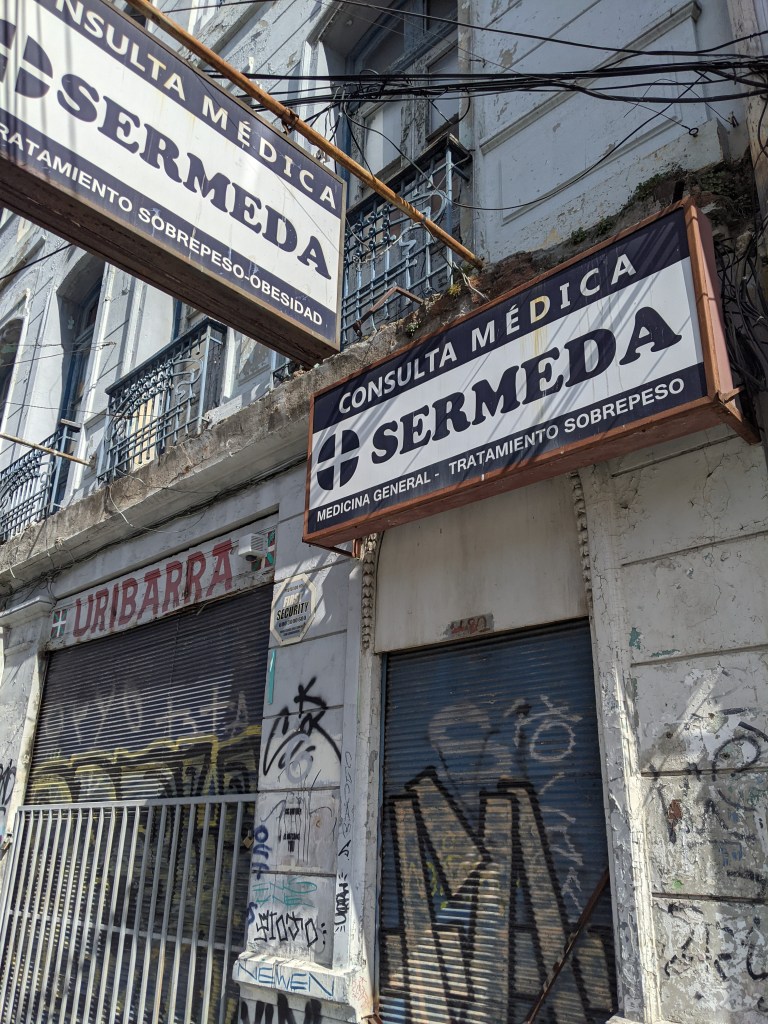
I climbed back up Jacob’s Ladder once more and walked around the perimeter of the cemetery to the main entrance. Valparaiso is a city full of street art, although not everyone has the same amount of skill. Some of it is amazing and some of it is simply vandalism. Almost every building and shutter is covered in spray paint, to the extent that it seems to be an insult if a building isn’t covered in paint. The only place that has escaped this is the emergency room and even that has some crudely drawn tags quickly scrawled across the wall facing the street. The cemetery just about escapes this fate, out of respect I hope.
The scaffolding was still in sight, but it had moved a few metres to the left, leaving the archway free for me to stroll in and up a gentle incline that curved round to the right, into the main body of the cemetery. The path up was flanked by flowerbeds on either side and immediately I could tell that this is where the rich and influential people of Valparaiso were buried. Nearly every structure in front of me for 50 metres was a mausoleum; all of them impressive but some bordering on palatial with huge pillars supporting temple-like roofs topped with crosses. Once more, headless angels guarded many tombs but this time they were in abundance. There is something very disturbing about a mausoleum being guarded by two headless angels, beckoning me forth with their arms outstretched.
This cemetery lacked the serenity of the one I visited yesterday as the entrance was straight off a busy road, but as I walked further in the sounds of the street and the cars revving and skidding their way up the impossibly steep hills of Valparaiso faded into the background. What it lacked in tranquillity it made for in simply spectacular ways. Some of these mausoleums were easily larger than many houses built into the rock. Some resembled palaces, some resembled places of worship. As I peered through the gates of one, I could see a staircase that ran deep underground and I began to wonder how many people were buried just in this one singular marvellous marble shrine. The only thing that dampened the spectacle were the structures that had been cordoned off due to their slowly crumbling forward into the paths beneath them, an inevitable side effect of the region: vulnerability to earthquakes. The ground here, much like yesterday was a jigsaw of dented and mismatched pieces of sandstone that had cracked and fallen away, causing me to trip numerous times. Today it was worse, owing to the fact my eyes were permanently looking up some of these tombs. As I walked around in awe, the names were predominantly Spanish, with just a sprinkling or German or English. The most common after Spanish was a mixture: one Spanish name and one German or English name, a nod less to the immigrants but the ones who mixed together. Only three Cornish names appeared this time, as members of wider families with different surnames throughout. These are the minority of Cornishmen or women who perhaps assimilated better into the wider Chilean society:
- Sergio Ossa Bunster, d. 22nd April 2008
- Rodolfo Goldsworthy, d. 25th December 1991
- Guillermo A. Goldsworthy, Godoy d. 3rd June 2002
- Francisco Tregayen B., (unmarked)
The names I found in the cemetery yesterday suggested that most Cornishmen who came over brought their families with them, slightly averse to mixing with the wider population. This is a product of the fiercely independent ‘us v them’ mentality that the Cornish held, probably a reaction to generations of English hostility. Or, it could be the old clay country motto, ‘keep it in the family’. I suppose, also, that learning Spanish if you had a very thick Cornish accent could be quite difficult. Theoretically in the 19th century they were speaking English, but it might well have been Cornish dialect and slightly incomprehensible to many Englishmen, meaning they had to translate from Cornish to English and then English to Spanish. If Trevithick never managed to learned Spanish, the likelihood others also failed to is high.
The groundsman and an elderly woman talked quietly facing a tomb, eyeing me slightly as I did the rounds. I found a bench in a quiet corner and sat for a few minutes to write these thoughts down in my notebook. I pondered on the prevalence of headless angels. Was it a deliberate act of vandalism? A religious warning? Bad craftsmanship? Or did the wild winds of the coast cause heads to roll? I stood up and scanned the cemetery for the groundsman, whom I saw trudging round the corner. I skipped after him, but he managed to disappear into thin air. There was no one else to ask, so the mystery of the beheadings would remain just that for now as I am due to leave Valparaiso tomorrow and I have yet to do any of the touristy things I had planned, like visit the Maritime Museum and La Sebastiana, the house of Pablo Neruda.
I left the cemetery, still in awe of the displays of wealth. Many of the mausoleums were padlocked and I began to wonder how much wealth was buried within the tombs. Did the smashed window imply the existence of graverobbers?
I walked back down the hill and as the terrain levelled out the minefield of dog shit returned. At a busy intersection, a man unzipped his flies and had a piss while leaning on a lamppost. Not very subtle, yet no one batted an eyelid. At this site I turned round and went back up the hill, calling into a little craft brewery I spied on my way down for a beer. If one thing is cheap in Chile it seems to be beer, but not here. Hipsters, I sighed, this definitely is Chile’s answer to Falmouth.
 JOEL GRIFFETT
Leave a comment