
Pre-order ‘Long Road to Nowhere: The Lost Years of Richard Trevithick (Part One)’ now, HERE.
After 5 weeks away I arrived back in my favourite place, Santiago. A week was enough first time round, now just one night seemed excessive. I had grown so used to the tranquillity of Pucón that when I emerged from the night bus into the morning smog of a megacity awakening, I nearly went straight up to the desk to book the next bus to Copiapó, another 12h ride north. Only a sadist would want to spend 24h straight on a bus so I decided against it, purely so I could sleep in a bed for a night. This meant I had to trudge up and back through the city twice because of my resolute stance on transportation: if I can walk there I will.
My short stint back in Santiago was gloriously uneventful for a change, short of nearly missing my bus north because I am an idiot who couldn’t find the terminal entrance without having to ask someone. Last night I’d had a very dull dream about the Salon Cama seat I yearned for, the one right at the back on the right hand side. No one next to me, no one behind me. Bliss. And now here I was.
Midnight.
Sat at the back of a salon cama heading towards the Atacama.
The closest I’ll ever come in my life to actual glamour.
When I woke up it was light. The grey morning was obscured by the condensation on the windows. Once I wiped the window with my sleeve without bothering to sit up I saw for the first time something I’d always been fascinated by: the desert landscape. Arid, barren and while occasionally disturbed by a town or city, nearly empty of life and noise. The bus wound gently down the slope into Copiapó as the town began to spring to life. This was still an industrial town, so things got going well before 10am here. The contrast between town and nature was stark – a distinct separation between the edge of the desert and the beginning of the urban sprawl.
I watched the hustle and bustle once more from the warmth of my seat. These buses felt like luxury to me and I was really beginning to love them as a mode of transport. Ambient lighting and comfy seats that recline 140 degrees are enough to allow even the most restless and violently twitchy sleepers like me to drift off into a realm that resembles sleep. Even though I was sweaty, I didn’t particularly want to leave because I awoke with a headache and the noise and noxious fumes of the bus station at 7am was not something I was prepared for. I’m already beginning to wonder how much of this trip will just be me describing my own dishevelled state as I roll into yet another new strange town very early in the morning running on little more than a few hours sleep and an eclectic mix of coffee, jam, bread, bananas and the odd cigarette.
I finished my breakfast of champions first at the bus station and then in a park before heading over to my hotel which conveniently was nigh on empty, meaning I could check in right away. By the time I’d repacked my bag for the six millionth time in six weeks and had a shower, I headed out to look in the museums. Both of them were closed, one indefinitely. Instead I chose to wander the rest of town during the hottest part of the day. Copiapó still resembled many of the old photos I’d seen of mining towns, narrow dusty streets, buildings rarely stretching above two-storeys, until you come onto the wider main roads and ugly high-rise apartments tower before you. It was surprisingly green for a place where it allegedly never rains.
I was heading for the old train station. The Copiapó-Caldera line was the first ever railway in South America, opened in 1851. A long time after Trevithick no doubt, but undeniably impossible without his efforts and those who built upon his ideas. The day the line opened was a momentous one. So momentous in fact, that the man tasked with driving the train got so pissed he couldn’t stand up, let alone operate the locomotive. The directors were worried for the passengers’ safety, so they scrambled round desperately trying to find one of his colleagues who could just about walk in a straight line. They succeeded, and no one died that day.
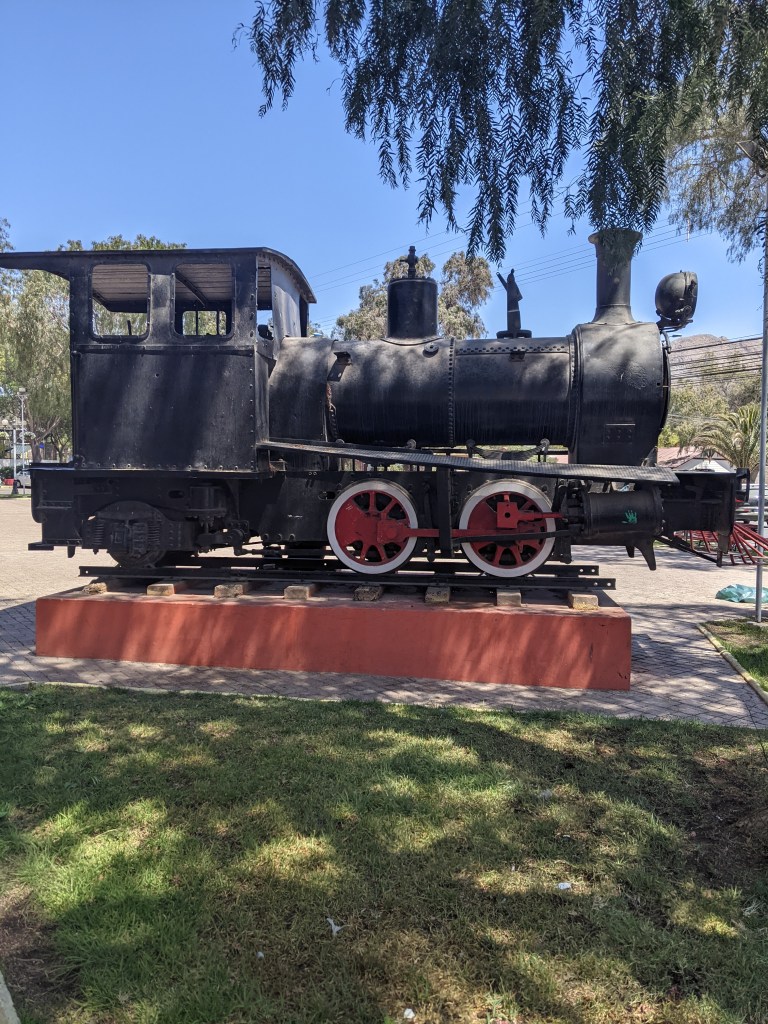
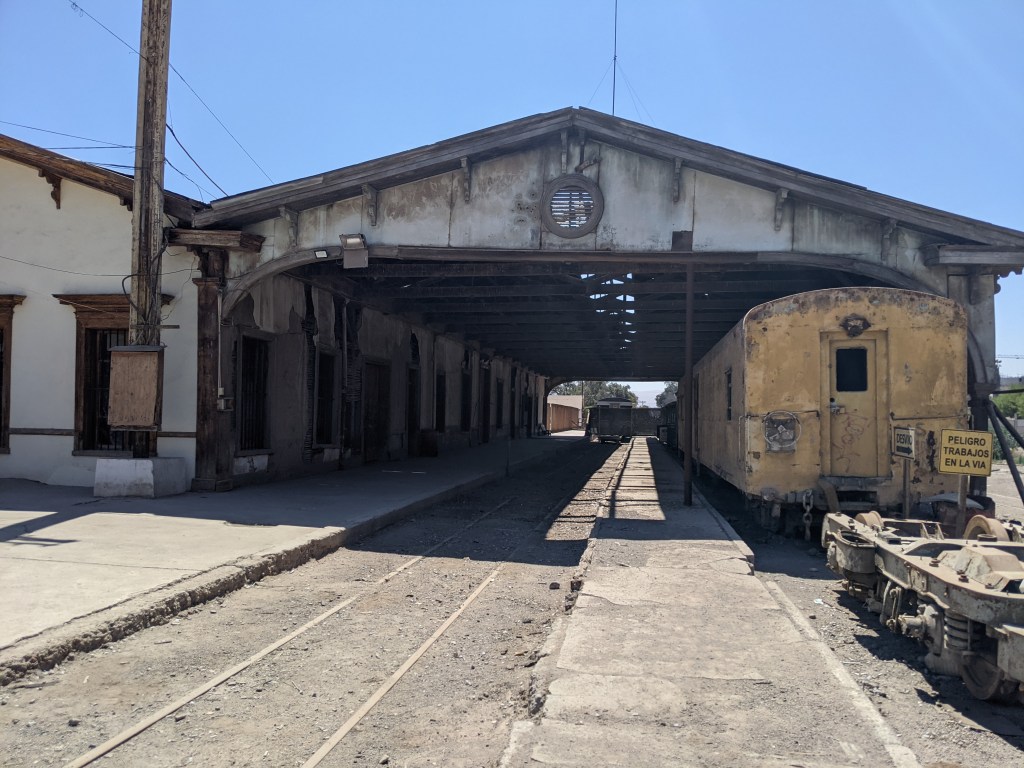
One giant locomotive and another novelty-sized children’s edition flanked the grand old station house, still maintained by the look of the whitewashed walls and varnished doors. I went up to the towering doors and gave them a push. No luck. But for a woman sat in the shade of the larger locomotive, the square was deserted. I looked for a way in, a gap or a fence to climb over, but the perimeter was guarded by spiky iron bars and as I walked further round, a prefab concrete wall topped with barbed wire. I walked around the corner onto a dusty road. The iron rails shot off left, emerging from behind two padlocked gates that led into the station. I stood between the two rusting rails and looked ahead. They ran dead straight for kilometres in front of me along a strip of wasteland. I was intrigued to see how far they ran. All the way to Caldera I suspected, but first, I wanted to get into the station. Concrete walls and barbed wire faded as the station backed onto a sad looking scrapyard, lacking even in scrap.
A woman emerged from a shack with a cigarette in her hand eyeing me suspiciously as I obviously looked for a way down. I found a gap, clambered carefully through it without snagging myself on barbed wire, and then scampered across the yard and under the gates on the other side of the station. The rails heading east were also still intact. I’m sure I heard the woman call after me but the voice sounded hesitant so I didn’t look back. As long as I didn’t hesitate myself and make it obvious that I knew I shouldn’t be here it was fine. Never show doubt. Pretend like you’re supposed to be here. No one came after me, but I’m certain I just indulged in what some might call trespassing. I would agree, but there was no explicit warning saying ‘keep out’ nor a sign saying private property. Perhaps the great wall was enough to deter the more cautious trainspotter but not me – I’d come too far and was clutching at too many straws to give up so easily.
All around me, Trevithick’s vision lay in tatters. A once romantic form of travel; once the pinnacle of technology and the fastest way to transport cargo to and from the mines lay obsolete before me, left to rust and gather dust in the desert. The station shut forever in 1978 and despite the upkeep of the station house and some indication of tourism, it felt as if I was one of the first to visit the abandoned yard for some time. Modern non-puffing devils and old carriages were dotted around the yard. I forced my way inside, the handles so stiff that half the rusting undercarriage sprinkled onto the floor as I barged inside. The corridors were narrow, the seats were not well suited for me. Jumping back down, I went and stood at the main platform and surveyed the decay around me. Given the railroads made Chile what it is today – arguably one of the most advanced and modern countries in South America – I thought there would be more interest in this kind of history. For the first time, the railroads made this unbelievably long country seem navigable but such is the nature of the modern world. Only looking forward, never back. To but a few, history is just a hindrance, a waste of time. What’s the point in celebrating the antecedents to modern transport when we take it for granted?
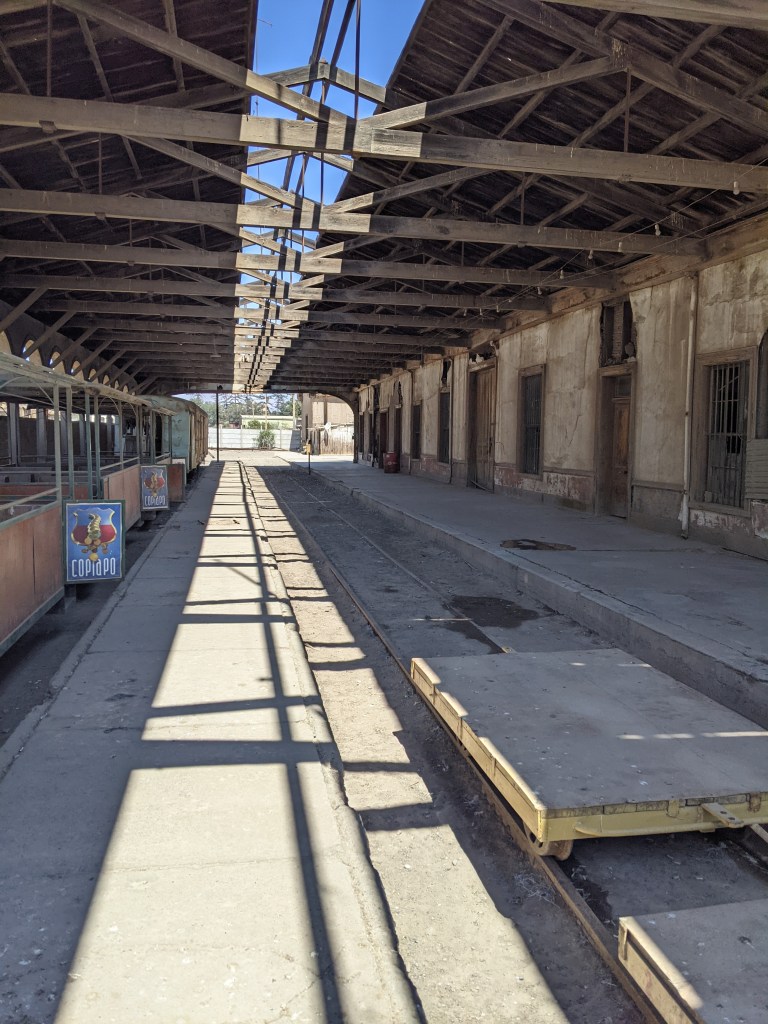
Aforementioned cars drove past the road above the station, curious passengers looked down to see what I was doing (little more than taking photos) but on the whole no one gave a toss. How fitting, I thought, given how obsolete trains became that no one even cared about trespassing here in the first station in South America’s history.
I vaulted a wall where the barbed wire had come away on the opposite side of the yard and headed for the tracks, still visible over 170 years after being laid. They stretched as far as I could see, in a strip of wasteland reserved for nothing more than parked cars and litter. Either side, those same prefab concrete walls stared down at me, this time protecting the end of people’s gardens from prying eyes. I walked for a kilometre or two, the tracks running dead straight and untouched along this strip. It was impossible to tell whether this was done out of respect or because the wasteland had no other use. The tracks appeared to end when I got to the highway and I nearly got runover by following my feet instead of looking up at the traffic before me but lo and behold, they had simply paved over the tracks and years of usage had worn the tarmac away. The tracks were still visible and they continued further across the highway into more wasteland. Me and a juddering crackhound crossed the road at the same time, much to the dismay of the speeding motorists. The only difference was my lack of unintelligible screaming at nothing in particular. All in good time…
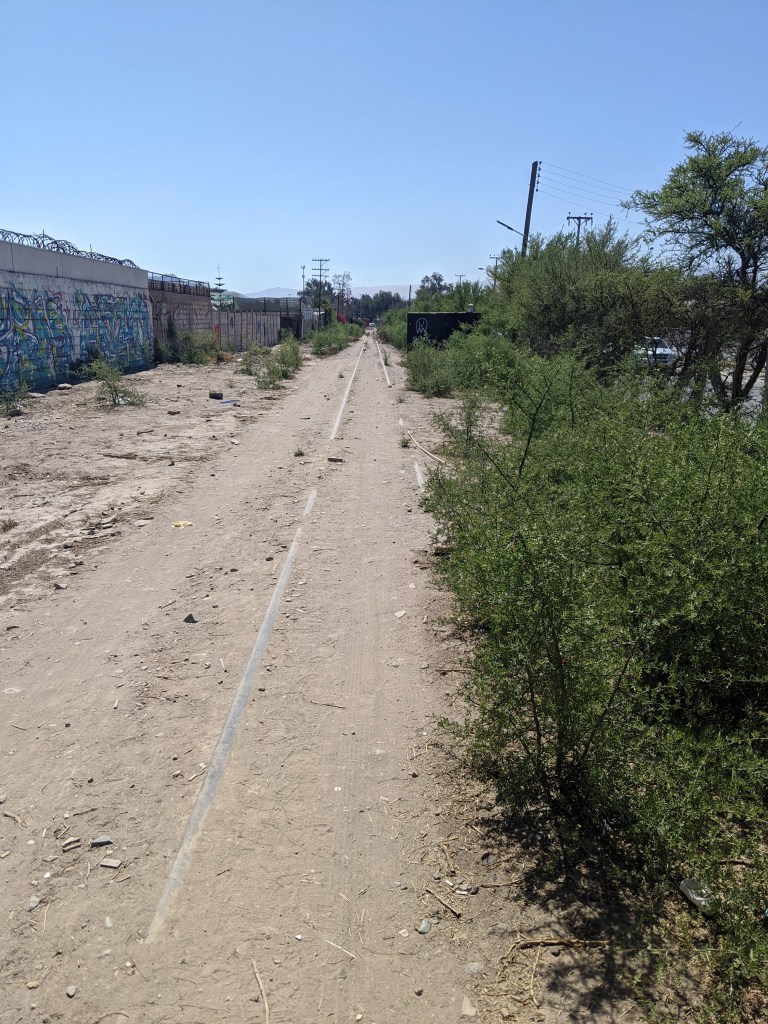
For a brief, overly romanticised moment I had the idea of walking the entire way along the line to Caldera as a kind of symbolic act to Trevithick and those engineers who came after him. Later, consulting the maps I saw that the highway essentially mirrors the rail route and that walking 81km next to a busy motorway wasn’t the romantic or symbolic journey I initially thought it was. The next best thing was to hitchhike to Caldera instead. I kept on walking along the tracks until I came directly parallel to the highway and then turned back, nearly getting runover once more as I crossed the highway (I still look the wrong way at every crossing despite being here for at least 6 weeks now). The thought of 2 or 3 days walking through the desert with nothing but the interminable roar of traffic rushing past my ears was not an enticing prospect anymore, but I’m on the hunt for symbolism wherever I go.
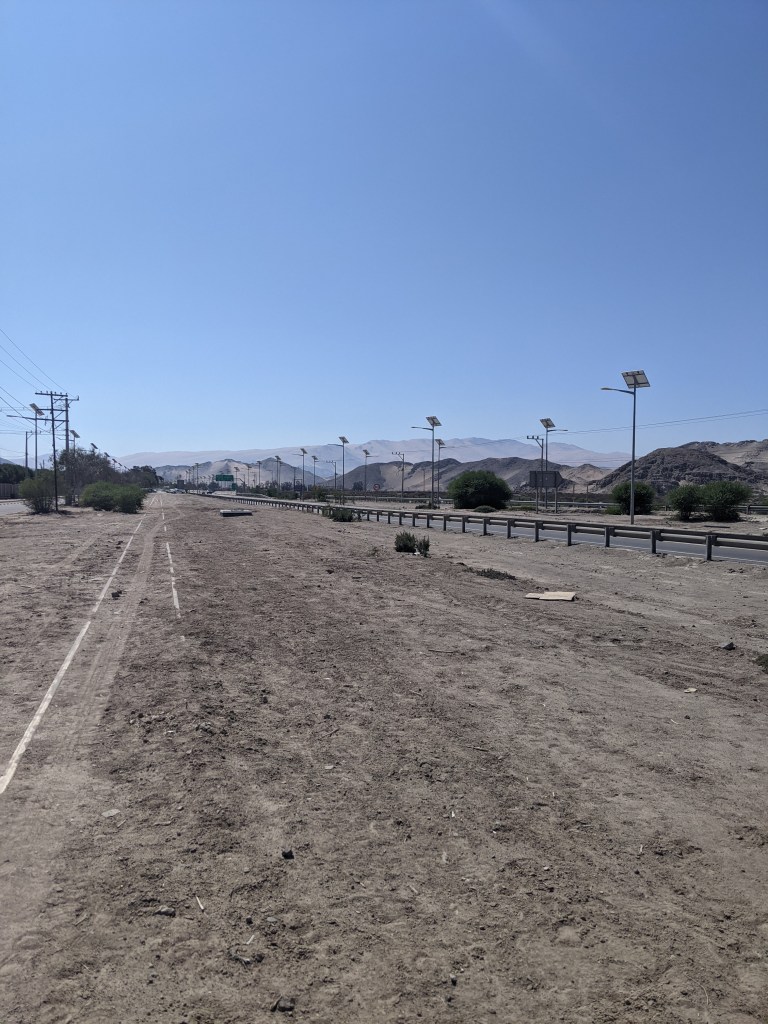
Despite this, I was certain that most of the track would remain uncovered as the rails wound out of the town and into the desert proper. Perhaps even seeing the railway ties underneath perfectly preserved, unless they’d been ripped up and repurposed. My next stop on this whistle stop tour was the La Copiapó locomotive, preserved in the tranquil grounds of Universidad de Atacama a few minutes’ walk away. Tis a hefty bit of kit, Cap’n Dick would be proud.
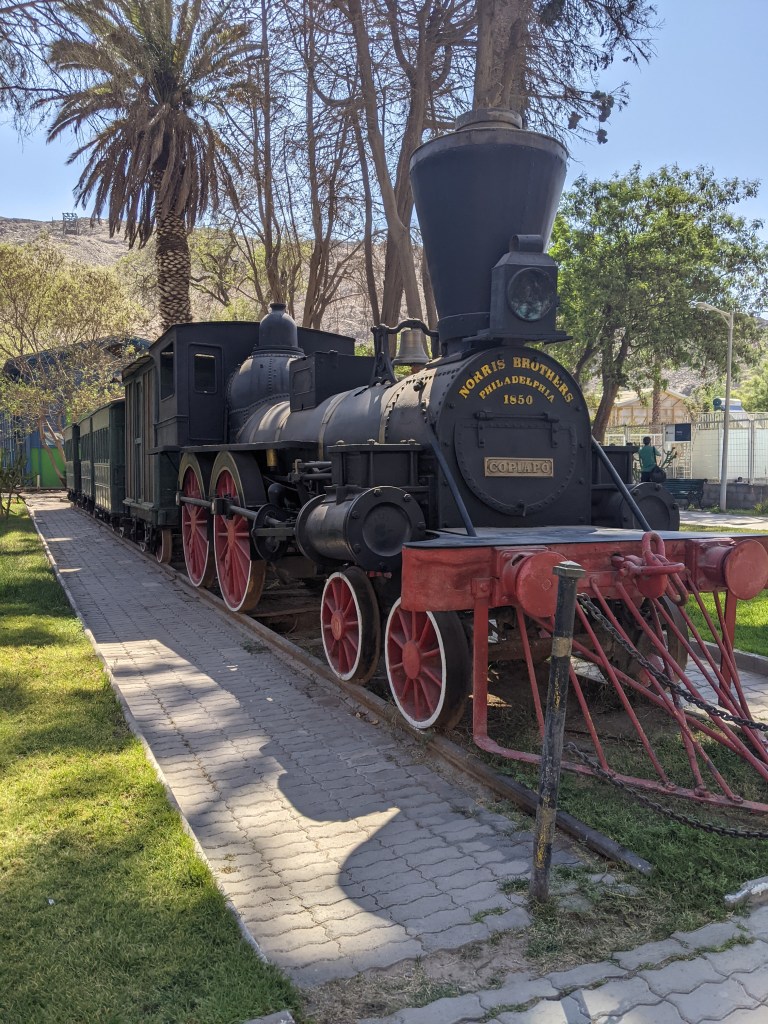
Now, I’m sure some of you might be wondering, (why) have I become a trainspotter? The truth is, I haven’t, although I can see why you may think that. I’m not particularly interested in the trains themselves despite my Grandad’s best intentions when I was growing , but I am for some reason fascinated by abandoned stations and disused railway lines (so maybe something stuck) and it’s just an added bonus that it all ties back into Don Ricardo.
***
I went and sat on a bench overlooking the river and stared idly into the abyss, wondering if there had ever been water in it. A river in a place with no rain just seemed silly. I was debating whether to buy a tent. It would certainly come in handy if I was going to hitchhike across the desert, but my bag was already full and I didn’t fancy overburdening myself with all manner of stuff strapped to the outside of it. As I sat looking thoughtful, a man walked slowly past, spotted me from the corner of his eye and stopped in front of me.
‘You shouldn’t be sat here,’ he said. I couldn’t tell if it was advice or a threat.
‘Why not?’ I inquired.
‘Bad people. Dangerous people,’ he assured me, nodding to a group of men gathered round a bench a few meters away.
‘And the wind,’ he continued, shaking his head, ‘always the wind,’
‘The wind?’ I stuttered.
He nodded solemnly.
I couldn’t help but look confused, so I thanked him for his advice and he swaggered off, right up to the group of men he’d just warned me against exchanged greetings with them all. Definitely a threat.
I decided against the tent. Maybe next year when I haven’t got a mission to attend to.
As the sun began to set over Copiapó I hiked up Cerro de La Cruz to get a good look at this unfamiliar landscape before I headed to the coast in the morning. The endless steps built into the hillside reminded me of Valparaiso’s own Jacob’s Ladder and once I reached the top I learnt once and for all that nothing, not even the Lord God and His Cross, is exempt from the spray paint of Chileans. The landscape is fascinating. Impending ridges rise like wrinkles from the depths of the earth. Perilous sand dunes cascade down and stop the march of civilisation any further than the existing limits of the city.
Heading north, I ascended one ridge, then another, then another. They went on for hundreds of kilometres. This is why Copiapó is the beginning of the end of the world and this landscape would be enough to drive a man mad. I nearly got myself lost during my short sunset stroll when all the paths back towards the cross began to look identical. It feels like another planet, a secret one hidden between the moon and Mars and over the next few weeks I was to head deeper into this mysterious territory.
If you enjoyed this article please like and share and comment and all that good stuff. Please follow the blog as well, so you’ll never miss a post. I promise I’ll actually find some trace of Trevithick (just not in Chile)
 JOEL GRIFFETT
Leave a comment