Pre-order ‘Long Road to Nowhere: The Lost Years of Richard Trevithick (Part One)’ now, HERE.
I awoke very early in the morning to what sounded like some very industrial techno beating down over the town. The hotel was next to a building site but it was far too early for work to begin and the beat was so oddly rhythmic that I couldn’t tell which it was – enthusiastic construction workers or someone in the hotel with a huge speaker and a drug problem. This racket was almost gabber, a form of dance music for people who have almost lost their grip on reality. The techno faded away as the lone raver passed out, but when I awoke again I couldn’t breathe. I felt like I was about to die. The room I was in had no windows and between the techno racket and now presumably all the oxygen in the room had run out, so all that was left was farts and nitrogen. I stumbled down to the kitchen in search of teabags and thankfully found the ones that read ‘mate de coca.’ I put two into one mug and drew some hot water from the urn on the side. The coca plant is God’s natural remedy for the effects of altitude and while I knew it would help, the foul-smelling brew before me did not seem so holy – it smells almost artificial. Nevertheless, I gulped down this odd beverage and made myself another one. The flutter of my heart and my breathlessness slowly subsided as if by magic and I praised God and Pachamama for this holy plant.
The coca plant on its own is an extremely mild stimulant mainly used to combat the effects of altitude. In Peru, Bolivia and parts of Argentina it is legal but everywhere else it is not, because nowhere else has oedema-inducing mountains. Everywhere else, it is simply the base ingredient for cocaine, but the finished product is so far removed from the plant that you need at least 350 kilos of leaves and a vast array of things like bleach, petrol and rat poison to extract the right alkaloids from the coca leaf to make a single kilo of cocaine. So don’t worry, it’s not like I’m smashing cocaine for breakfast.
A few hours later I headed out in search of a bus to Pulacayo, a ghost town around 45 minutes from Uyuni. Pulacayo and the mine of Huanchaca, hidden further up in the mountains, were the main reasons I had embarked on this Bolivian detour. They were frequented by another mysterious Cornishman: John Penberthy.
The running theme amongst many of these Cornishmen, from Hicks to Trevithick and now Penberthy is their stubborn and belligerent nature. Upon his arrival, Penberthy was horrified at the time-wasting and idleness of some of the miners at Pulacayo and endeavoured to make the mine more efficient. The devil makes work for idle hands, so Penberthy instilled his own Western and Christian ideas of time and work ethic into these lazy men. His move was so unpopular that it actually worked, just not in the way he’d hoped. The men sprung into life and hatched a plan to assassinate him, hoping to bring an end to the scourge of Western men and their silly relentless work ethics. He survived, remained unphased and implemented his regimen regardless, making it one of the most profitable mines in the world.
So the legacy goes…no more information was disclosed, but nevertheless I went in search of more information before and after my visit to Pulacayo. The results were disappointing.
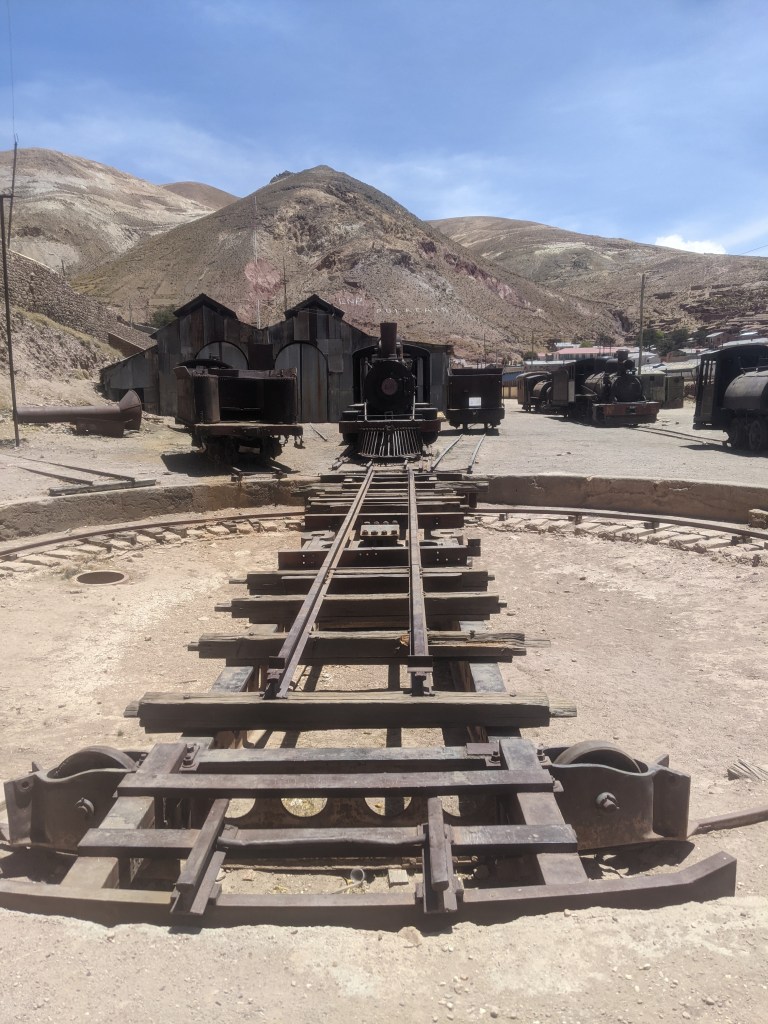
Jumping off the bus by the highway I was immediately confronted by reality. Pulacayo isn’t a ghost town – it’s almost a ghost town, which makes it even more creepy. I had expected the entire place to be deserted but around 800 people still live here. In the days of boundless silver it was tens of thousands more. It used to be almost as important as Potosi, 4 hours east, and the first ever railway in Bolivia was built between Pulacayo and Uyuni in 1890 when the Huanchaca Company and CSFA (of George Hicks’ fame) merged to make the mines of Bolivia more accessible.
There is a rough divide between the two halves of the town; down in the valley, closer to the highway, red stone buildings are left to crumble. Higher up, just past the second train graveyard I’ve seen in two days, there is one street that gently slopes up to a pitiful plaza and then snakes round to the right. The train graveyard of Pulacayo is nowhere near as grand or interesting as the one in Uyuni. A few locomotives and carriages lay idle and most of the tracks have either been ripped up for scrap or paved over. On the way up I saw a ridge carved out of the mountain that curves along the slope and it looks as if it eventually led back into Uyuni itself, but I lost sight of it as the bus went round a hairpin bend.
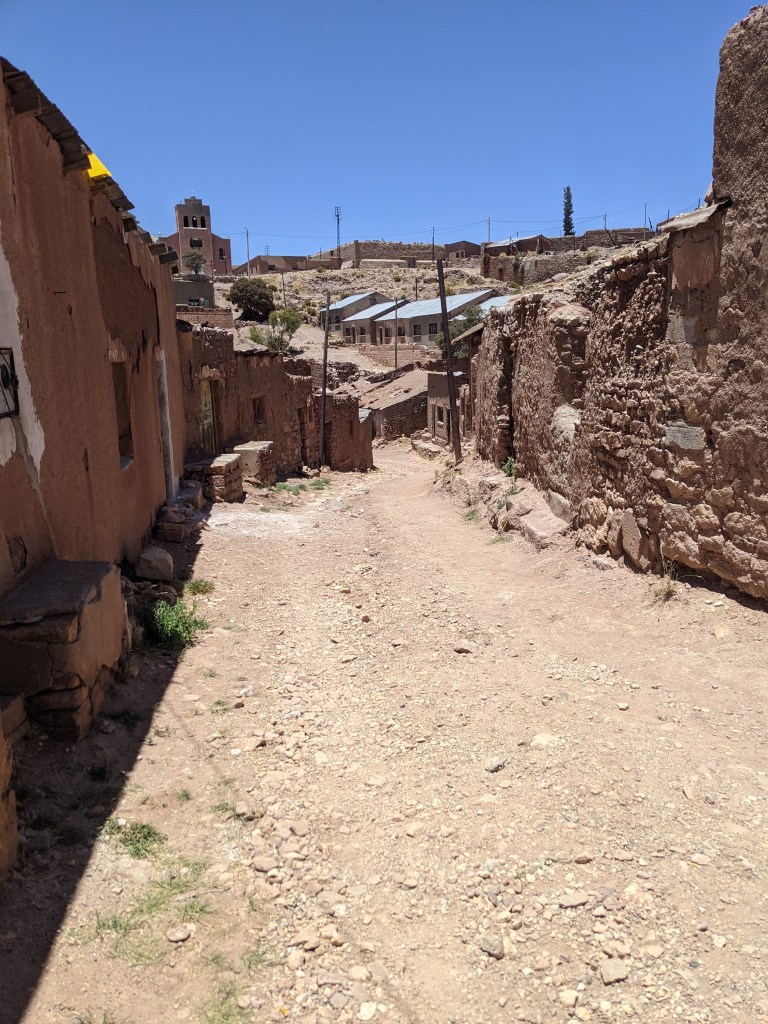

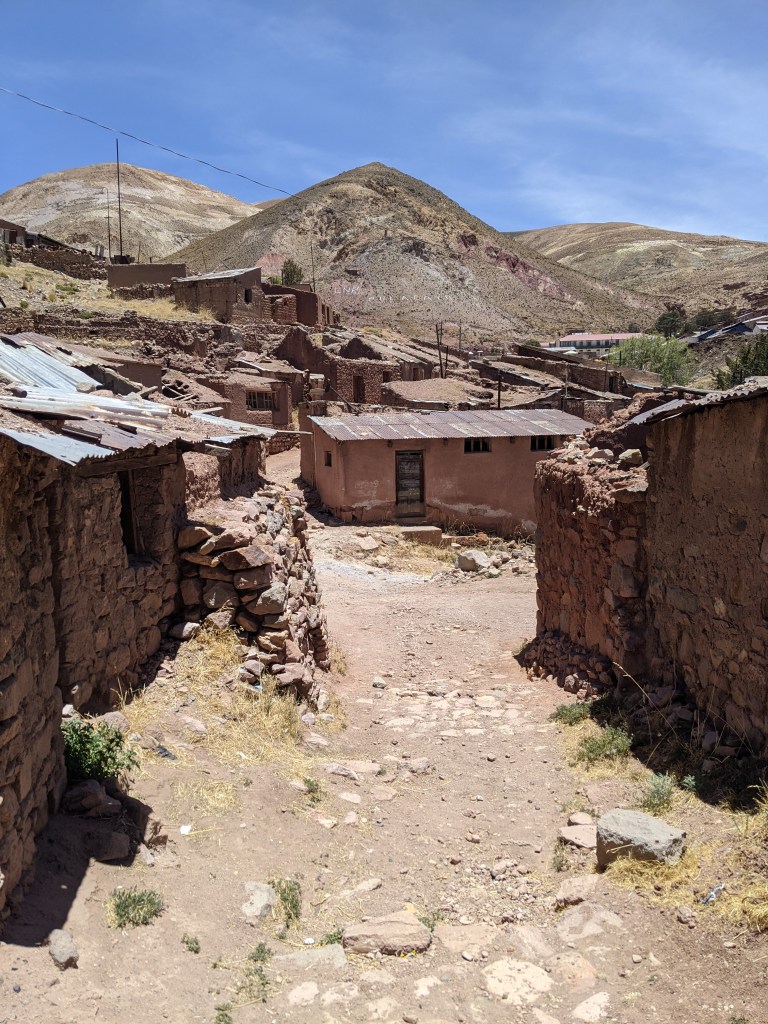
Signs of life dangled limply in the Andean breeze; a pasteleria here, a panaderia there, but on closer inspection these small shops had long since passed and the street could easily have been part of Flambards Victorian Exhibition. A few young men slumped lazily in doorways. One disinterestedly called out to his friends further down the street who didn’t hear. He didn’t bother trying again, taking another handful of coca leaves from the translucent green bag and stuffing it in his mouth. When I reached the ‘plaza’ there was one woman and her stall selling a pathetic display of biscuits outside a school that couldn’t have been more out of place. From within came all the signs of life not yet beaten down by the Bolivian economy and the brutal Andean sun that turns the face of everyone over 40 into a ballsack with a mouth; a mouth full of slowly decaying stumps where teeth once used to be.
Obviously dentistry is a first world privilege, but in Bolivia the lack of access is worsened by the sickening array of fizzy drinks on offer. The first one I tried – Inka Kola – is bubble-gum flavoured and has the appearance of a mildly radioactive hangover piss. Luminescent yellow, the alcoholic inspector of Chernobyl churns out Inka Kola into a bucket next to his desk and then sells it to Coca-Cola, who distribute it all over South America for no other reason than to rot the teeth of those who don’t bother buying a toothbrush.
In the valley below stones houses crumble, once home to those who came to mine the silver out of Huanchaca, a mine second only to Potosi in terms of size and value. Every tiny habitation was filled with modern rubbish, Kola and Cola bottles and various plastic wrappers. It’s convenient I suppose, when your neighbour moves away in search of new opportunities you can start using their house as a rubbish tip. Who needs binmen when there’s plenty of empty houses to fill up instead?
As I stumbled further down into the valley there were still signs of life echoing from within the buildings that hadn’t yet crumbled but the overarching vibe was an eery silence. An isolated, almost 4000m high silence. Very little life, the faint murmur of those stranded here and the swirl of the wind above. This eery scene was pierced by a megaphone and the revving of a lorry which had clearly just arrived to sell fruit and veg. From the hill above with ‘Pulacayo’ pebble-dashed into the side, all the way to the bottom of the valley where I stood, the man and his megaphone made an ear-splitting racket that made me yearn for the eery silence of before. It was unsettling but at least it was quiet.
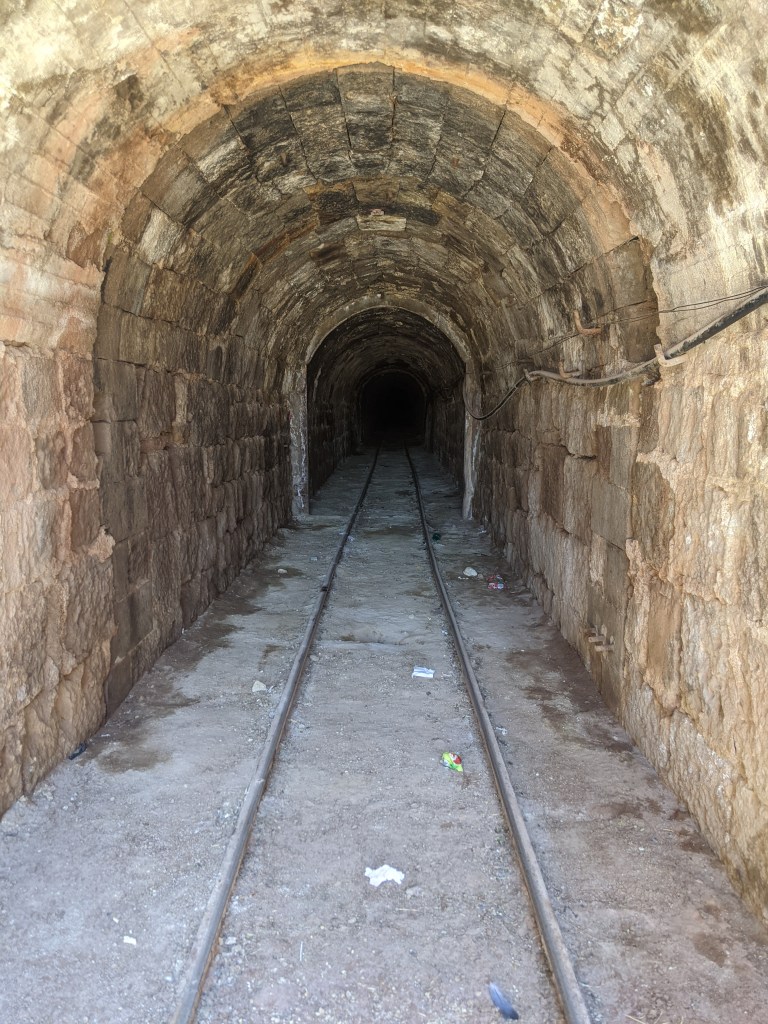
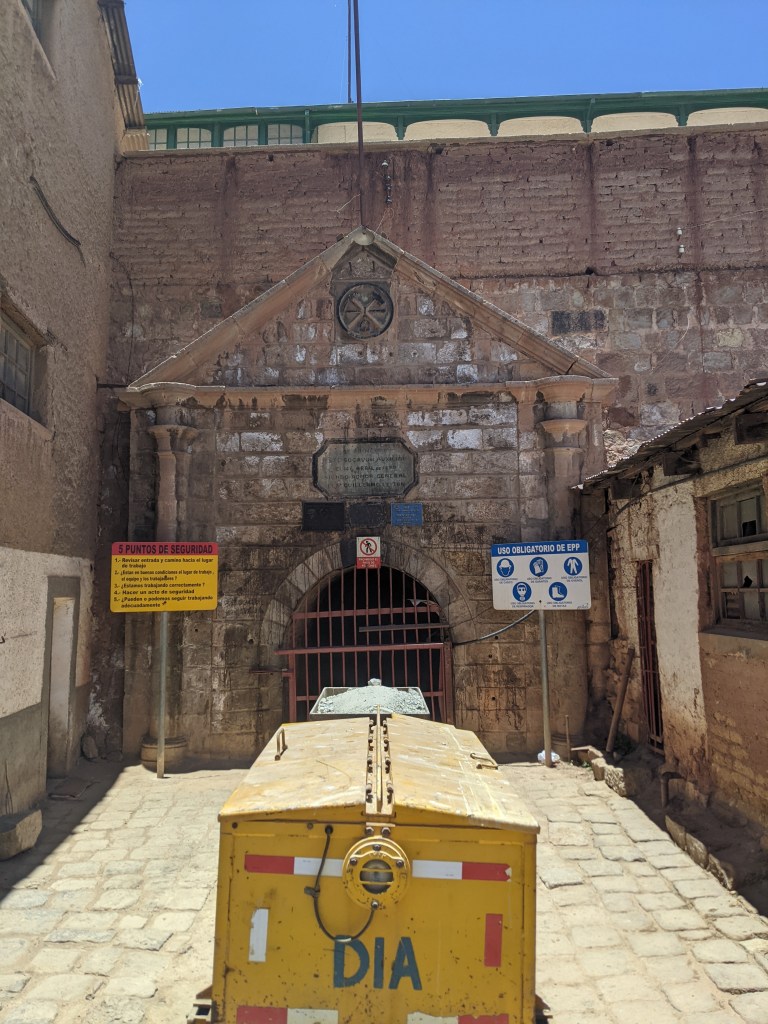
I didn’t know what to do. The museum was shut (my bad timing continues) and the man in charge was more interested in his lunch than this foreigner wanting to look around. He told me to come back in an hour but for some reason I didn’t believe him. I stumbled upon the entrance to the mine shaft, which was dotted by all the signs of 21st century industry. An ominous sign with all the boring health and safety notices, modern yellowy-orange hand carts for extracting mineral. Both of these suggested that the mine was or had reopened recently, but the complete lack of personnel and all the smashed windows in the buildings that flanked the entrance suggested otherwise. The rails curved off to the left around a ridge, with the old foundry sagging proudly next to it.
I heard a muffled voice from somewhere behind me, up the steep bank of rubbish next to me. I saw a bobbing white hard-hat float closer to the edge and a small, pale man appeared.
‘There’s nothing down there,’ he told me.
‘I know, I’m just following the rails’ I replied innocently.
‘You saw the entrance to the mine?’
I nodded and he ushered me up the slope.
‘Is the mine still working?’ I asked.
He nodded enthusiastically, ‘Silver,’ he said, ‘and lead,’
He must have been deaf from working in the foundry because he shouted every word even though I was less than a metre away. His booming voice echoed through the valley just like the man and his megaphone.
‘Paolo,’ he declared, sticking out his hand.
‘Joel,’ I replied, pronouncing my name with the same French affectation I cannot avoid whenever I go to a foreign country.
‘Where are you from?’ he asked.
‘England,’ I replied, and he repeated the word in a very strange, almost non-Spanish accent.
‘Ah, England. Lots of machines here from England,’ he said.
I nodded. Most of the locomotives I’d seen in the last two days were built in England.
‘Workers too,’ he continued, pointing down at the crumbling stones I’d just walked through, ‘England, France, Germany’ he said, pointing out a row of houses with a stubby finger.
‘How far away is the Huanchaca mine?,’ I asked expectantly. Maybe I could hike up into the mountain and find some more ruins.
’Pah, 12 hours,’ he said derisively, ‘Muy lejos,’
‘By car?!’ I was surprised.
‘No, no, by foot. In a car maybe 1 hour,’ he assured me.
Something didn’t add up but either way, I wasn’t going to Huanchaca today. When I looked on Google Maps later that evening, it only seemed about 8km as the crow flies, but clearly the terrain wasn’t favourable. When I zoomed in, I could make out more ruins, hidden away deep in the mountains.
‘You live here, no?’ I asked, changing the subject.
‘Of course,’ he said proudly.
‘Do you like it?’ I continued.
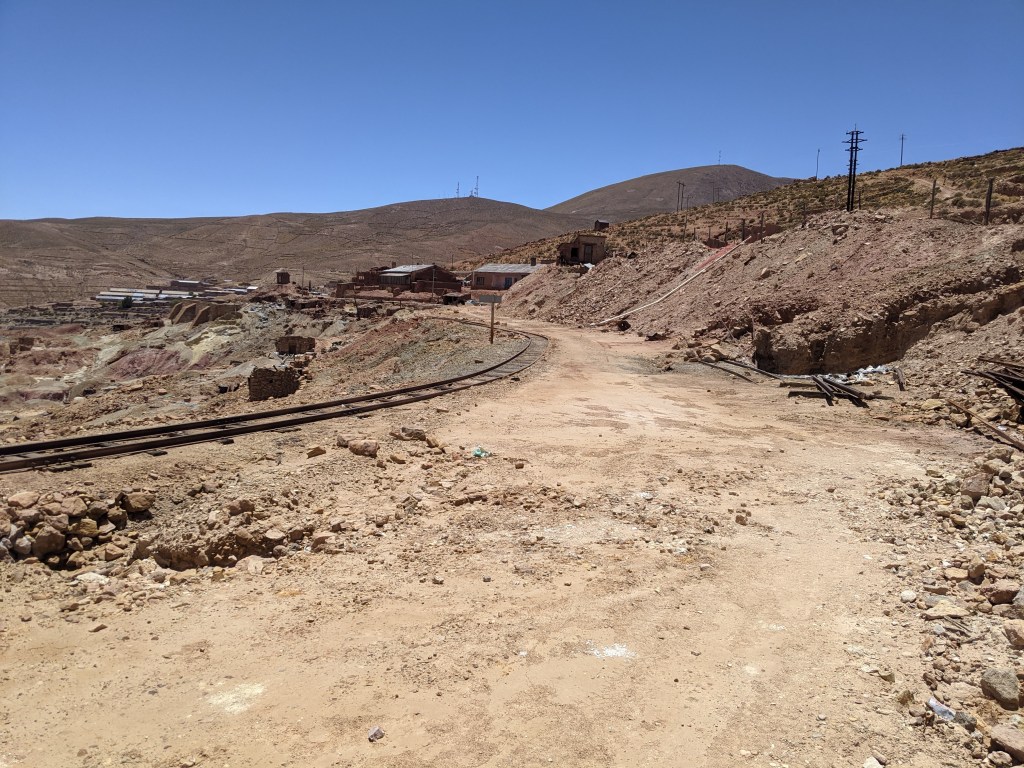
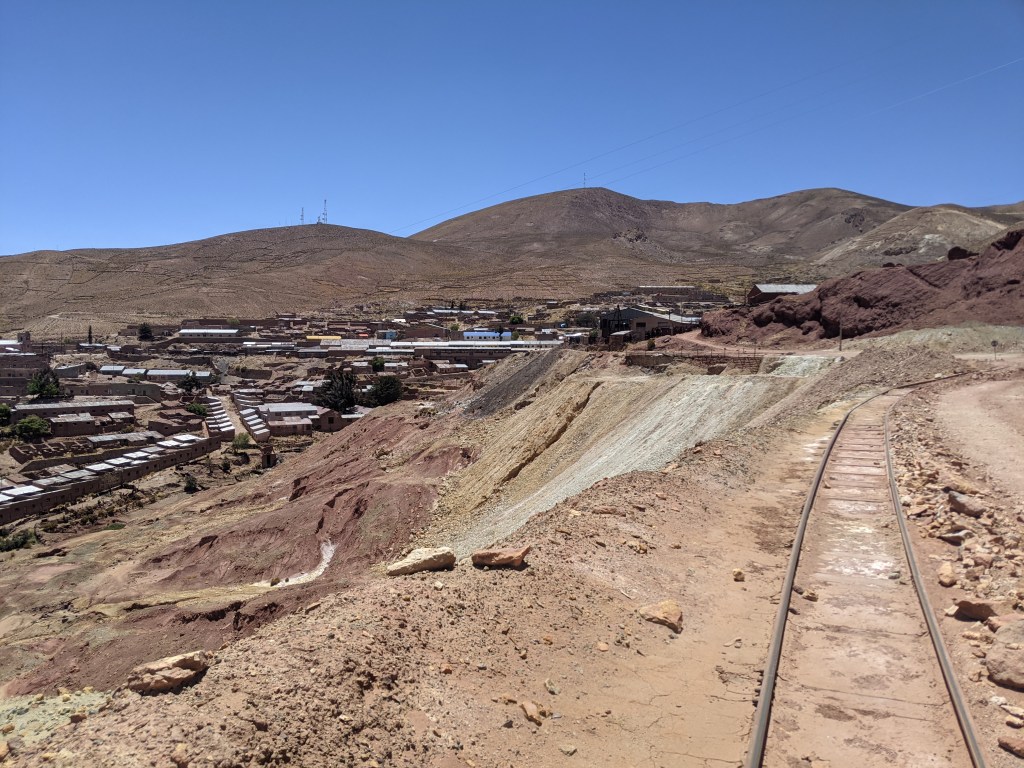
His face fell slightly and he didn’t answer, but I think I can make an educated guess. Searching for scraps of silver in a once famous mine, living amidst the remains of a ghost town without any shops or bars from what I could see. At least he wasn’t down the mine right now. The shafts that lurk beneath are up to 1000m deep, with temperatures hitting nearly 50 degrees. Hotter than hell, the workers had to drill naked and only for 15 minutes at a time otherwise they would drop dead. Apparently it was due to this area being a place of volcanic activity.
Paolo continued talking, words I didn’t understand. He was another unfortunate victim of Inka Kola and I don’t think he had any teeth at all. This, coupled with huge wad of coca leaves in his cheek rendered a lot of what he said almost entirely incomprehensible and I just nodded along until it was clear I’d lost track of the conversation completely. He shook my hand again, said he was going for lunch and told me to come back later.
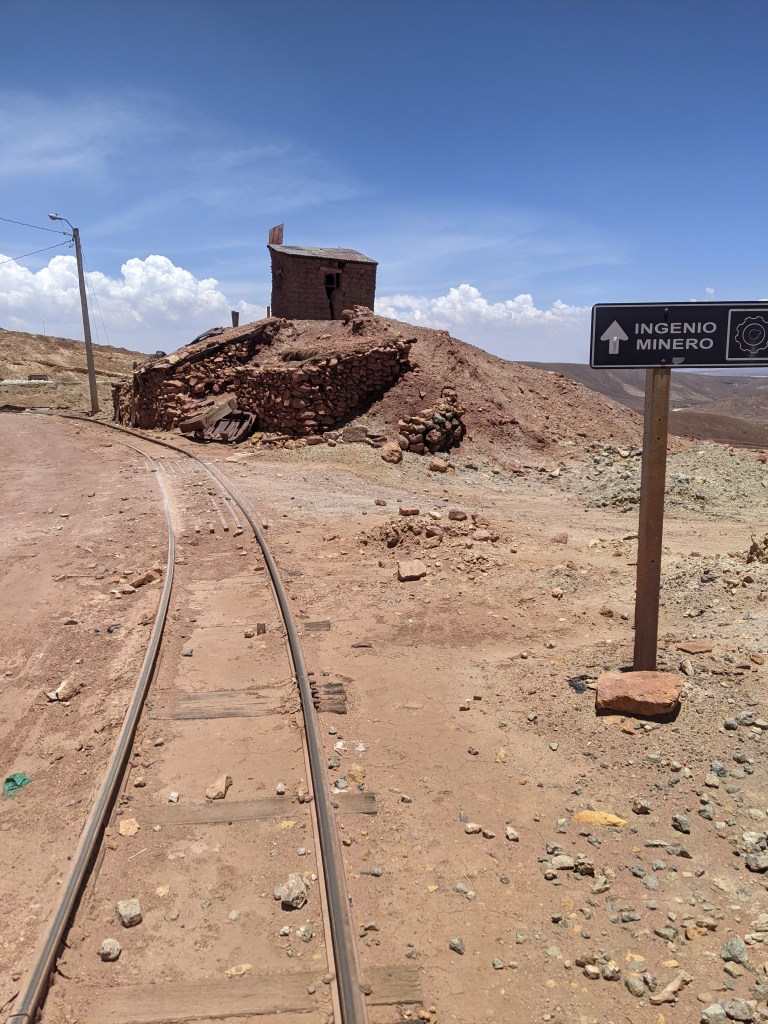
After Paolo went for his lunch I continued along the railroad to the end of the line and the ruins of the old foundry in a corner hidden away from the rest of Pulacayo. For the first time I was undeniably walking over ground previously trodden hundreds of years ago by one of the Cornishmen I was searching for, yet I felt as if I’d been duped..I stared up into the hills. Huanchaca was up there somewhere, 12 hours away by foot apparently. That couldn’t be right but I wasn’t about to disregard Paolo and start walking into oblivion, armed with nothing but my trusty boots, half a bottle of water and a handful of peanuts – I’d never be seen again.
I walked back out to the deserted highway feeling somewhat dejected and flagged down the first bus on its way to Uyuni. I needed to grab my stuff and take a bus to Potosi. Here I would venture into a mine for the first time, the infamous Cerro Rico.
If you can help me in any way with this project then please reach out and let me know. As always, please subscribe to the blog and like and share this post.


 JOEL GRIFFETT
Leave a comment