Pre-order ‘Long Road to Nowhere: The Lost Years of Richard Trevithick (Part One)’ now, HERE.
Leaving Sucre reluctantly after two weeks, I headed to the bus station. If you want Granada vibes on a shoestring budget, Sucre is the place for you. I was sure the bus hustlers were playing with me when I got there. The single bus heading to Oruro I saw on the noticeboard in the hostel didn’t exist and the rest weren’t due to leave until 8 or 9 this evening. It was currently before midday. Two quite forceful women grabbed my arm and told me of a roadblock between here and Oruro and that the only way to get around it was first to come with them to the office and buy a ticket back the other way to Potosi. With a Vulcan grip on either arm I didn’t really have a choice. My natural distrust of facts led me believe it was all a ploy, but I think they were right. The direct 5 or 6 hour journey to Oruro was soon to become 11 hours of pure discomfort. I first went back to Potosi, dozing and twitching into the man sat next to me as usual. By the time I’d got to Potosi all the day buses had left.
Short of returning to the hotel up in the old town I didn’t know what to do until I saw a colectivo lurking outside the terminal. A man and a woman took it turns hollering ‘Oruro ya sale.’ 80 bolivianos later (£10) I was sat stuffed into a minivan with 7 other passengers. It wasn’t a competition but I was by far and away the most uncomfortable, sat on a metal bar and the plastic trim where a seat should be. I’d paid for luxury but this was the least enjoyable journey I’ve made in a long time. The woman told me 4 hours, but it was closer to 6 when we reached Oruro. Every time I found a position that wasn’t complete agony, I was dislodged by a bump in the road and forced to reconsider my whole life. Worse still, I didn’t have enough biscuits to sustain for this interminable ride. 80 bolivianos isn’t much, but it’s more than I’ve paid for the other 3 buses between cities combined.
When I got there I stood in the middle of the road for a while, realising I’d been dropped at the old terminal, not the new one as I’d hoped. The new one and my hotel were miles away. It seems to be the Bolivian way to have two terminals in each city, and for it never to be clear which one you will arrive at. I was at the mercy of every single taxi driver (every single car in Bolivia) until the country’s smallest woman accosted me for standing in the road. I was quite done with today and she could sense it.
“Are you lost?,” she inquired.
I nodded, “sort of,”
“Argentina?” she asked
“Pardon?”
“You’re from Argentina, correct?”
“No, England,” I responded.
She frowned at me, “Where in Argentina is that?”
“Europe,”
“Where?” she was puzzled.
“Europe, not in Argentina,”
She didn’t look convinced, but hailed down a taxi on my behalf and bundled me into back before I had a chance to ask the driver if he knew the street. Luckily he did, so I thanked this deceptively strong woman and the taxi sped off. The women I’ve encountered today really put the ‘man’ into ‘manhandling’
A lesson learned: the illusion of time
The one day/night I had in Oruro was probably the most fraught and disappointing one of my trip so far, and my first outward realisation (it’s been dormant until now) that I don’t know what I’m doing. After I got in I went straight to sleep on a bed that barely contained my shins. In the morning I woke up and had breakfast, then as usual took an interminably long time to leave the hotel in pursuit of the museums I wanted to visit. I tell myself all the time I’m in no rush but that morning I was really taking the piss. Once the taxi dropped me off in front of the first museum, named after Simon Patiño ‘The Tin Baron’ I walked in and was quickly ushered out again. It was closed and didn’t reopen again for another 3 and a half hours – an acceptable length of lunch break in Bolivia. Instead, I went off in search of the mining museum, inside an old mine shaft but the place didn’t exist as far as I could tell. It was somewhere in my vicinity, near the Sanctuary of the Virgen, but for the life of me I couldn’t find it. I ascended a set of stairs up into the hillside, Oruro’s answer to Christ the Redeemer glancing at me through peripherals. Not even he knew where the museum was.
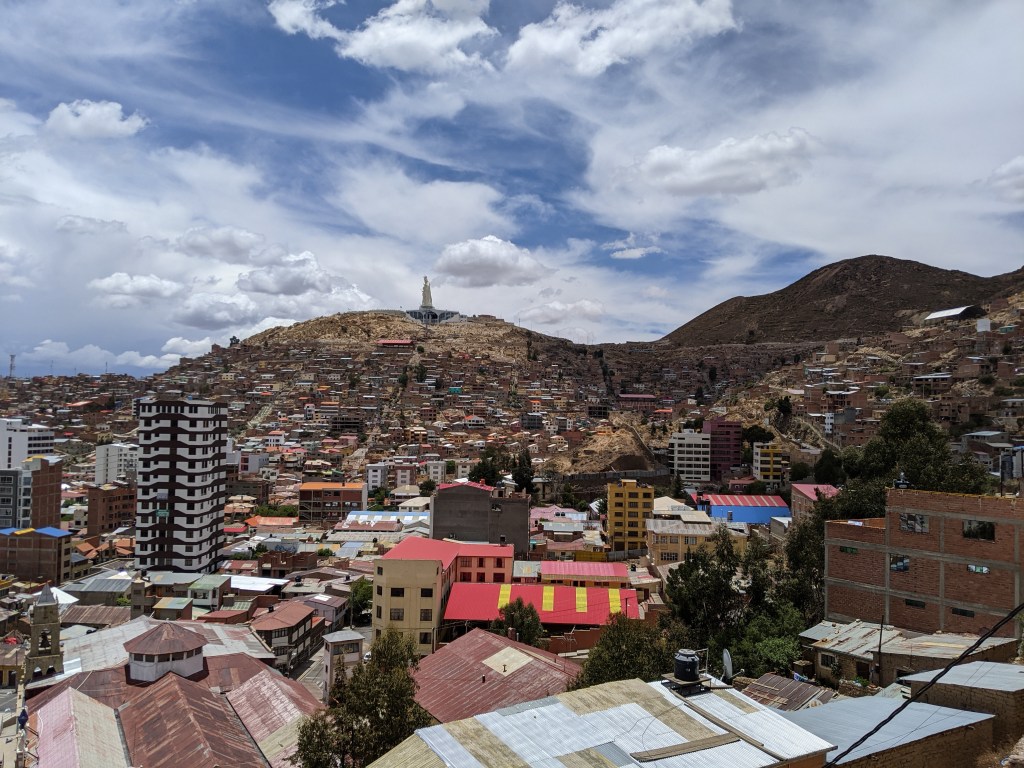
Back in the centre of the ‘plaza’ I ducked into the church, my footsteps squeaking across the cavernous hall. An office bearing the name of the museum appeared in the corner of my eye. I hovered in the doorway and watched the woman within predictably pack up for lunch. She also told me to come back in 3 hours. A hard life. As it turns out, the church and the mine are inseparable. Right at the back of the church, there is an iron gate that leads down a shaft to where the mine once was. The church itself is built into the rock. Bolivia is a very religious country but I was taken aback by this combination. In Potosi, Cerro Rico is a Godless place, hence why the miners worship El Tio. To see the two entwined, literally connected was very odd. I didn’t have time to wait 3 hours, I needed to get to La Paz and given the ordeal of yesterday I didn’t know how long it would take.
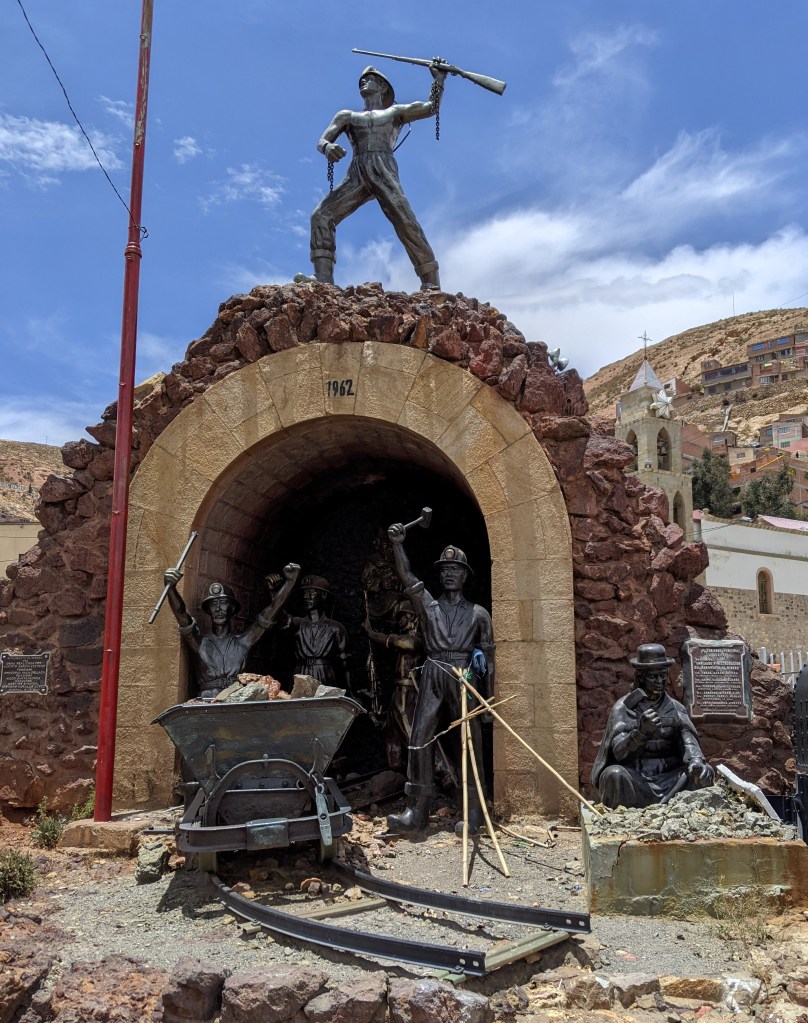
I went and slumped myself in a doorway of the Sanctuary and started to question my life again. Everywhere I go I arrive at the wrong time. If I really wanted to delude myself I could claim mystical forces were working against me, but realistically I’m just an idiot. Nothing more, nothing less. While I wake up a lot earlier than I ever did at home, I counteract this by dossing around doing very little most mornings, then, as midday approaches, I spring into life in a slightly rushed and panicked manner as if I was late. When I shuffle out of my lodging as 12 approaches, most places are shutting for lunch. Or, if I arrive on somewhere on a Friday, they’re just about to shut for the weekend. Much like Trevithick, my timing is atrocious.
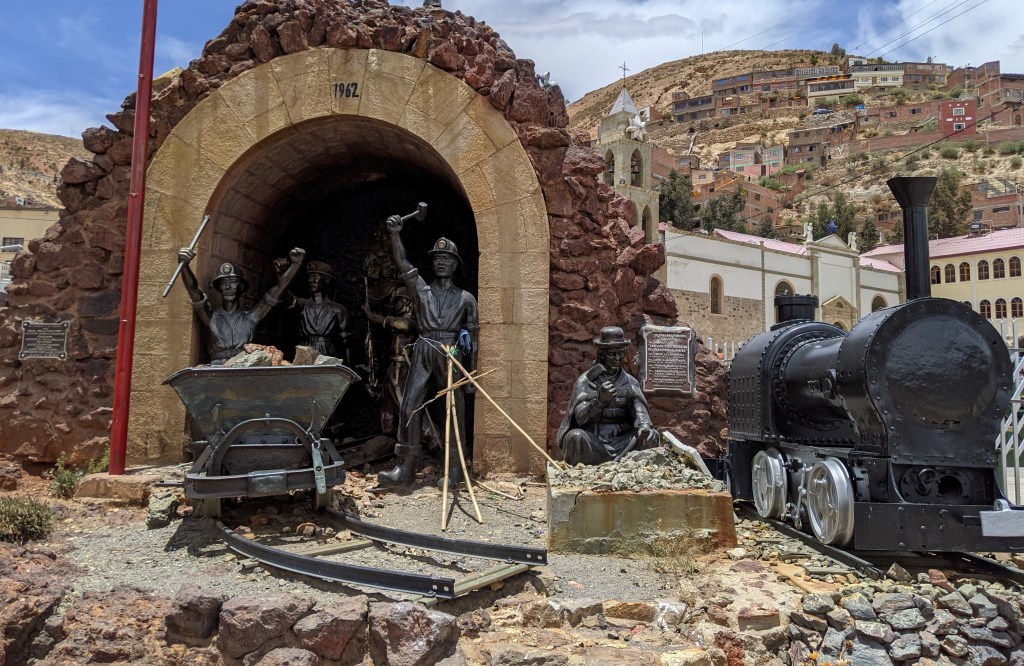
Make a bit more haste is the lesson I should learn from this. I still don’t know what to expect from this trip but the fact I remain my own worst enemy probably isn’t helpful at all. I could’ve waited around all afternoon for the museums to open but I didn’t. I went back to the hotel, grabbed my stuff and went to La Paz instead. Ironically it was the smoothest, quickest and easiest journey so far. Sounds about right.
 JOEL GRIFFETT
Leave a comment