Pre-order ‘Long Road to Nowhere: The Lost Years of Richard Trevithick (Part One)’ now, HERE.
War brought Trevithick back down the hill to Lima by 1820. The same chill that killed off Francisco Uville in August 1818 did the trick for me. Barely a week was more than enough to send me down the hill dreaming of warmer climes. My quick ride up and down the Andes made me appreciate Lima in a new way.
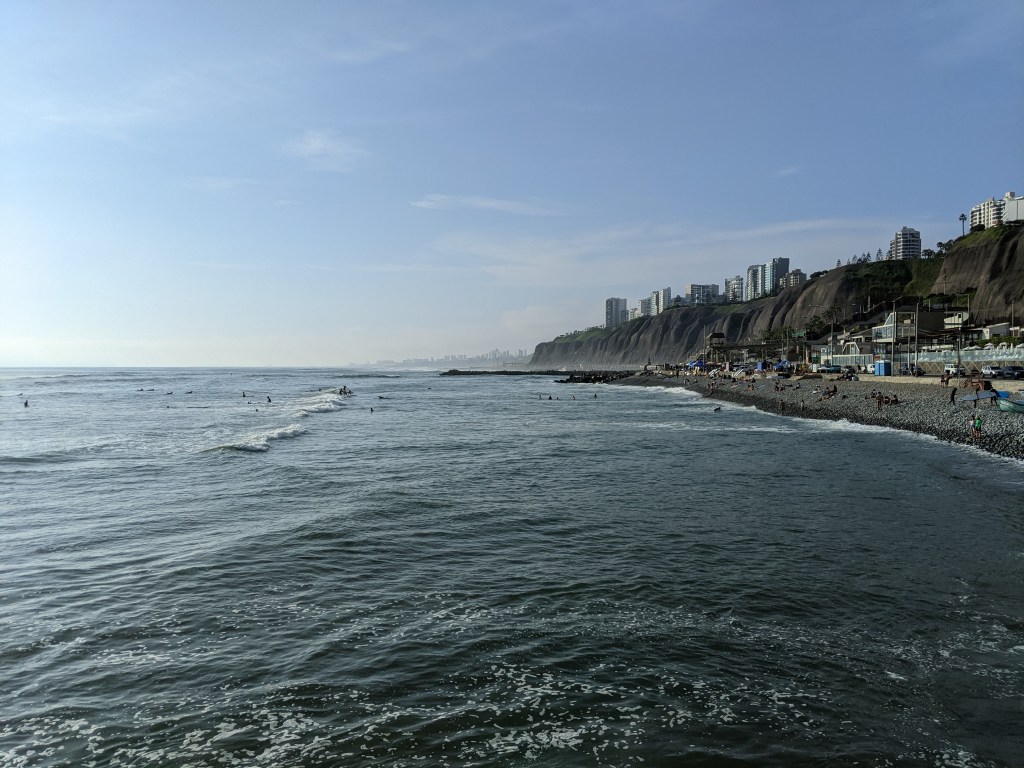
I was apathetic towards Lima before my short hop up the hill to Cerro de Pasco, but upon my return I had a newfound appreciation for Peru’s often maligned capital city. The old centre was a cacophony of car horns, but the suburbs closer to the cliffs that overlooked the Pacific Ocean were pleasant and even tranquil, something hard to find in a megacity. I never bothered with Lima’s beaches though. As a proud Cornishman, crossing an overpass above a 6-lane highway to reach a small rocky beach and seeing the sea covered in all kinds of questionably coloured sea foam never sat right with me, no matter how hard Jesus and his friends tried to convinced to come and surf. Seeing these contrasting images made me dream of Penhale Sands, quite possibly the nicest beach on earth.
It is very difficult to know exactly when Trevithick made his final journey down the hill to sea level, but December 1820 is the last conceivable point any sane man would have stayed in Cerro de Pasco. Almost everyone left long before; the work had dried up when the merchants had removed their investments from Lima, most of it carried back to Europe on British ships operated and owned by the likes of Gibbs & Co. If any foreign workers remained in the country, even after the Spanish government issued a decree expelling all non-resident foreigners from the country, they had little to do, succumbing to the seductive warmth of heavy drinking in a very nice climate. William Bevan stayed behind and managed to keep himself occupied, but the mines of Pasco would not begin to operate again until the end of the 1820s.
6th December 1820 and the beginning of the Battle of Cerro de Pasco was the final straw, but the month before colonial officials had sensed that there was little point trying to stop the inevitable. The oncoming charge led by Brigadier O’Reilly was already enroute through the Andes and the Intendant of Tarma, Gonzalo Prada, was preparing to abandon ship. He informed the Viceroy of his intentions and recommended everyone else in the regions of Junín and Pasco to do the same. Perhaps he was a coward, but Gonzalo Prada’s position was untenable due to a mix of ineptitude and disloyalty in the royalist ranks. Power hungry careerists ready to switch sides to suit their own aims and the good old Latin temperament letting them down. Only a few years before Prada had sung the praises of Trevithick and his engines to be the saviour of the mining economy. Barely 4 years later, he had been swept away by the incoming tide of Revolutionary politics without a whimper. The mines were left to stagnate until 1825, and any meaningful output from places like Cerro de Pasco did not begin again until well into the 1830’s. Trevithick’s short-lived dream for Peruvian riches had finally come to an end.
From 1820 to 1824, the town became a playground of war. All the equipment was destroyed – the royalists ruined machinery to stop the patriot forces getting their hands on ‘Spanish’ silver and the patriots ran riot because mining was the ultimate sign of imperial power. Not even Trevithick was insane enough to stick around; no one would wish to spend 4 years on the bleak high plains of Pasco with nothing to do. Instead, he passed his time bored in Lima.
Other than his unacknowledged involvement in the salvage of cargo from the sunken ship, it is almost impossible to know what on earth he did in Lima for 3 years after work ceased in the mines. He may well have gone to Chile in this time, before heading north to Costa Rica at the end of 1823. He can’t have been there for more than a year, owing to what I found in the vaults of the national library of Peru: a report dated 8th November 1822 about the mines of Pasco, bearing the name of Richard Trevithick himself. The first and perhaps only thing bearing his name in existence in all of South America…
I’d grown so used to chasing rumours and hearsay that something concrete almost didn’t feel real. It was too good to be true; the BNP (no, not that one, the Bibilioteca Nacional del Peru) held in its vaults a text written by none other than Don Ricardo Trevithick. Odd I thought, given he never spoke Spanish. I can only presume he had it translated, otherwise he was keeping his cards very close to his chest. Could this explain his tour of Peru and the special passport granted to him by the Viceroy of High Peru after leaving Cerro for the first time? Could this shed some light on his prospecting in Cajatambo and Conchucos?
The Forgotten Document
I laughed at the man weaving through the traffic lights selling giant pencils until I arrived at the library and realised I didn’t have one. The world’s worst historian stuttered into action once more, this time into the National Library of Peru. All I had left was the singular, precious pen with me, the only one I hadn’t yet lost. I didn’t think I’d need a pencil until I sat down at the reception to register and was informed that some of the documents were in the ‘Fondo Antiguo’ which sounded very archive-like.
I’d only been to two archives previously – the Middle East and North Africa archive of St Antony’s College, Oxford and Kresen Kernow in Redruth both of which were spectacular affairs of glass, with hermetically sealed chambers carefully air-controlled to prevent all manner of old handwritten documents from disintegrating in the filthy modern atmosphere. There I was not allowed to bring anything inside the chamber except a pencil and clean hands. Then again, I remembered I was in South America, and that no one gave that much of a shit about health and safety or preservation in the same way eccentrically dressed old professors winced when even talking about such things. This was lucky for me, not just because I didn’t have a pencil with me. The lady behind the desk snatched the ones back that I was trying to steal, looking at me suspiciously, as if I was some kind of thief.
The world’s worst historian finally gained access to the library, but only after the best part of an hour trying to register for my ‘Investigator’s License’. I was asked the same set of questions twice by two separate people. Once the first round had concluded, the first woman stood up and I had foolishly presumed I was sorted once I’d paid the small admin fee. But no, her colleague sat down in the same chair and we began again with an identical set of questions. Martin’s wry little warnings about Peruvian bureaucracy were proving right time and again. I suppose he was well aware of it after 25 years. Eventually, ID card in hand I strolled into the library feeling for the first time like a legitimate researcher. I went straight to the top floor to read some old books. Trevithick’s document lived on the 2nd floor. When I reached the 2nd floor ‘coleccion extranjera’ I didn’t realise I was about to be sent on another wild goose chase, from this desk, back to the fourth repeated ad absurdum.
This was typical, rushing up and down the stairs like a fool I was convinced that no such document existed and that Trevithick had taken every precaution in 11 years to cover his tracks entirely. By the time I had confirmed it was in fact on the fourth floor the woman went into the vault once more. She emerged after a concerningly long time, empty handed. She passed by me and returned to her desk.
“It’s very fragile,” she began, “Unfortunately it cannot be viewed”
I was distraught – the one thing actually bearing his name was here, it existed and was theoretically available for reading. Yet I couldn’t read it, just beyond the wall to stay there forever unread and untouched.
Given my limited Spanish in these more official scenarios I have let some prying left undone before now, but I was not prepared to back down so easily this time. I had to see this.
“This document is very important,” I insisted. “Nothing else remains of him in the entire of South America,”
She looked somewhat sympathetic to my plight when she could merely have been bored, but continued to put her foot down. She pulled out her phone and showed me the condition of the document – the pages were badly damaged at the edges and looked so brittle that they’d disintegrate upon coming into contact with my desperate and sweaty paws. Pages too old to touch – a document 201 years old. The cruel taunt that has been this search has culminated here in the ultimate pisstake.
Obviously, this wasn’t the end. After a moment of silence she gave me a lifeline. If some money changed hands, of course, the situation could be resolved. Given the incentive, the pages could be digitised and the resulting PDF could be sent to me in the slow course of Peruvian time, for the handsome fee of 70 soles (£15). I started to think this was all a ploy, a series of events almost pre-rehearsed. Denying me access, the brief interlude of sympathy before the marketing strategy was unleashed on me.
Can’t touch it for free, but for a small fee…(coincidentally this is also how the Americans find themselves a Latina!)
She showed me how to request the documents and I stormed all the way down the stairs faster than the lift and walked home through the rough neighbourhoods of La Victoria in a foul mood.
 JOEL GRIFFETT
Leave a comment