Pre-order ‘Long Road to Nowhere: The Lost Years of Richard Trevithick (Part One)’ now, HERE.
Just a few hours north-east of Bogota is where the very myth lies – the ultimate and most intriguing idea that South America is full to the brim with immense treasures. The hills and the deserts are rightfully rich in gold, silver, copper and even other things like guano and saltpetre, all lying in wait for the greedy hands of Europeans. The pre-Hispanic cultures of South America knew these secrets, but they were never blinded by quite the same greed. Precious metals were symbols of wealth, but not the wealth itself – the entire European monetary system relied on gold reserves and silver coins and unfortunately, the allegedly ‘inferior’ peoples of this continent were forcibly involved in the fetishes of these pale-faced inbreds.
The prospect of infinite wealth gave rise to the ultimate myth: El Dorado. A source of wealth so large it cannot possibly be true. Cerro Rico came closest to the realisation of this; silver emerged from Potosi in such abundance that thousands ventured to the city in search of their own personal fortune. But silver is second to gold in the European mind and something more improbable and fantastical has always endured. The Laguna de Guatavita, a couple of hours from Bogota is almost universally recognised as the home of the myth.
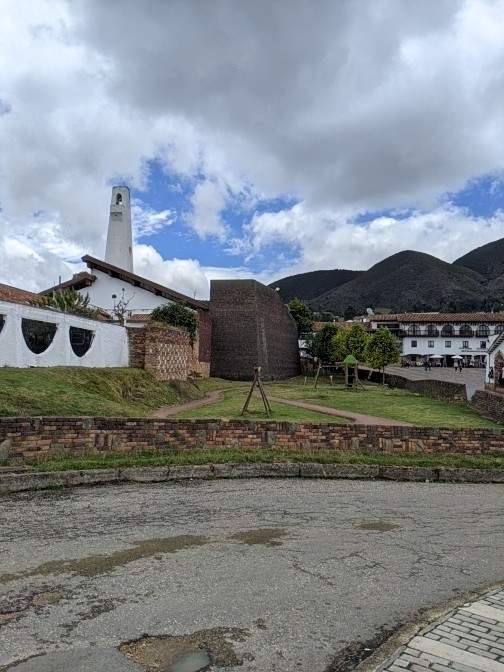
It wasn’t far but the small town of Guatavita was a different world to the noise of Bogota. New Granada, the old name for Colombia, suddenly became very appropriate; whitewashed walls, barrel roof tiles and low rise buildings, along with plenty of archwayed plazas gave it the look of a small village somewhere in the hills of Andalucia.
Perhaps I was a fool, but I didn’t consider how touristy Laguna de Guatavtia would be. The main square was filled with vans heading towards the site each morning, and just as one pulled away I jumped in, crammed into a tiny seat in a VW Transporter that somehow held 17 people: at least 7 too many. The population of Colombia is certainly taller than further south, but this van was more cramped than some of the local buses I’d stuffed myself in whilst in Bolivia. I sat uncomfortably with my head bashing against the ceiling as the main road turned into a muddy track.
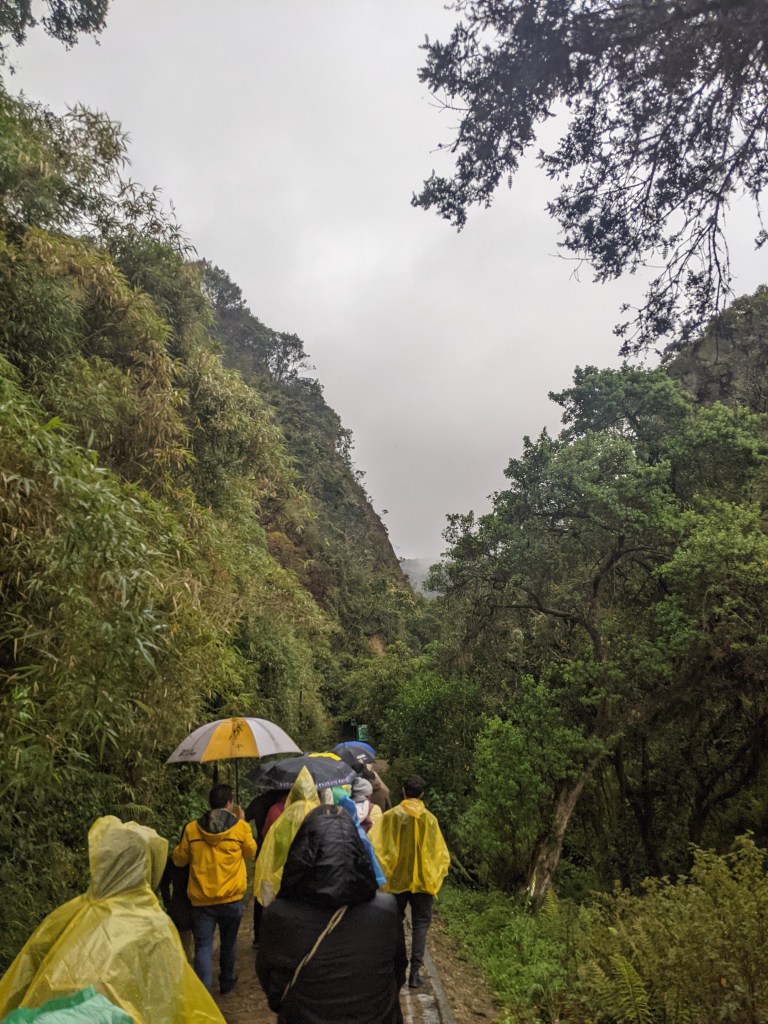
The grey early morning mist rolling over the hills gave the ascent to the site a more mystical quality, only to be ruined when the rain threatening since I awoke finally began lashing down. A sea of plastic ponchos and brightly coloured umbrellas were called into action. The faces beneath the bobbing plastic rainbow looked alarmingly down at my shorts and boots, as if jeans were more suitable for torrential rain. The abundance of impossibly pristine designer shoes made me think most of these people were day tripping from Bogota. I had assumed it was a hike up and around the crater but no one else seemed to have understood this message. Either they were unprepared, or I was over-prepared. Thus began an interminable hour or two of people stopping every few minutes along the guided tour to take selfies and pose at anything resembling a mirador. Most of the path up to the base of the crater was a red-brick road, a long driveway up towards infinite riches. At the base the bricks disappeared and a rocky, slippery path snaked up towards the summit. The pace up the hill was little more than glacial, presumably to ensure the girls had time to scrape mud from their Armani shoes. By the time I reached the top, stuck in the middle of this farcical caterpillar, I was rueing the fact I thought the lagoon would be anything but a tourist trap. All history fades into tourism, the only people willing to keep history alive must be happy to pay for it.
Obviously something as huge as the biggest myth on the continent wasn’t going to be a secret only a select few knew about, but given the sleepy small town of Guatavita that lay half an hour from the lagoon of the same name, my understanding had been warped. It was close enough to Bogota to require nothing more than a day trip from the capital. Only a select few unhurried travellers like me could stretch a whole day and night out of the town itself.
From Tijuana to Tierra del Fuego myths like El Dorado still persist, partly because the prospect of immense wealth will never get boring. Considering how much mineral wealth was extracted from the continent, first by the Spanish empire then by private companies of British, American, French origin, the idea of El Dorado is more reality than myth. All that’s lacking is the glamour and mystery of a man dusted in gold diving into a lake full of treasure. In real life, the silver and gold were harder to retrieve, only possible thanks to the slaves who died in their millions. This life was the exact opposite of glamorous, the only dust was the stuff coating the lungs of the miners who eventually died of silicosis.
The Spanish had it all wrong, not for the first time. Their insatiable greed had made them gullible. There was gold in the lake. There probably still is gold in the lake, but not to the extent the Spanish imagined. All manner of golden artfacts were tossed into the lake by the Muisca people, natives of the Colombian cordilleras, as an offering to the gods. To throw gold into the water was to create a pact to renew life. They recognised that while the gods had left all these treasures behind for them, they were also required to give something back to the earth that had been so kind to them. We could learn something from that, but instead we take, take, take; rarely offering anything in return, as if this world was built entirely to satisfy human greed. These so called ‘primitive peoples’ were far more in tune with the equilibrium of nature but the Spanish weren’t interested in their customs, only their gold. Seismic shifts like this, igniting human greed in a way that was once inconceivable has caused us to lose our way. Gold will never be discarded like this, it must be stockpiled, then fought and fretted over. A great psychic mutation that has allowed greed and paranoia to destroy our minds.
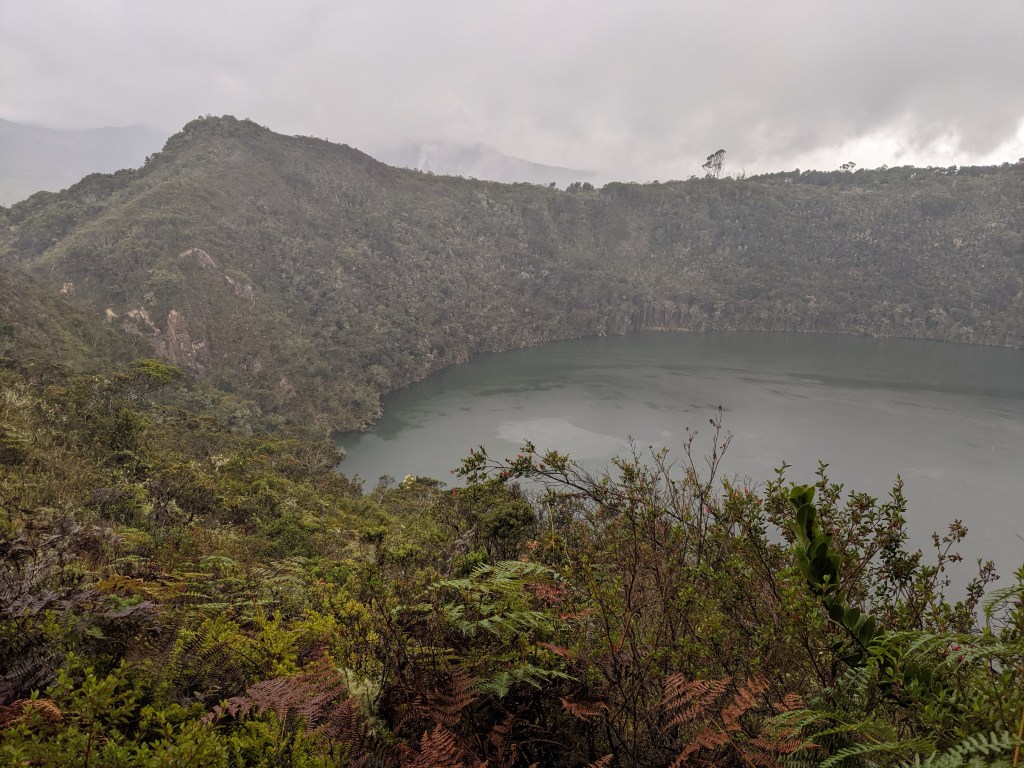
Looking down at the surface of the lake from the viewpoint atop the ridge of the meteor-like crater, this once noble tradition is long gone. Even the Colombians, predominantly those from Bogota with their now-muddied designer shoes had lost their way. They were all tourists for the day too. With none so much as a glance at the lake below, they jostled and fought their way to the barrier to take selfies. At the risk of sounding arrogant, I despair at the state of modern tourism. Any major tourist attraction, no matter how breath-taking and magnificent it may be, is now simply a photo opportunity. No one stops to marvel, to contemplate or to appreciate, they hurry through as if it is some kind of race, stopping only to take photos. Most only look at the place through their camera or phone screen before moving on. I’ve seen this at Alhambra in Granada; Alcazar in Sevilla and all over South America. Tourism is no longer about appreciating present moments in these places, it’s ticking off boxes on your own personal checklist. Being there is not enough, you must take photos to prove to everyone that you were there – that is more important now. Don’t get me wrong, I take photos, but that comes second to whichever mesmerising place I find myself in at that time.
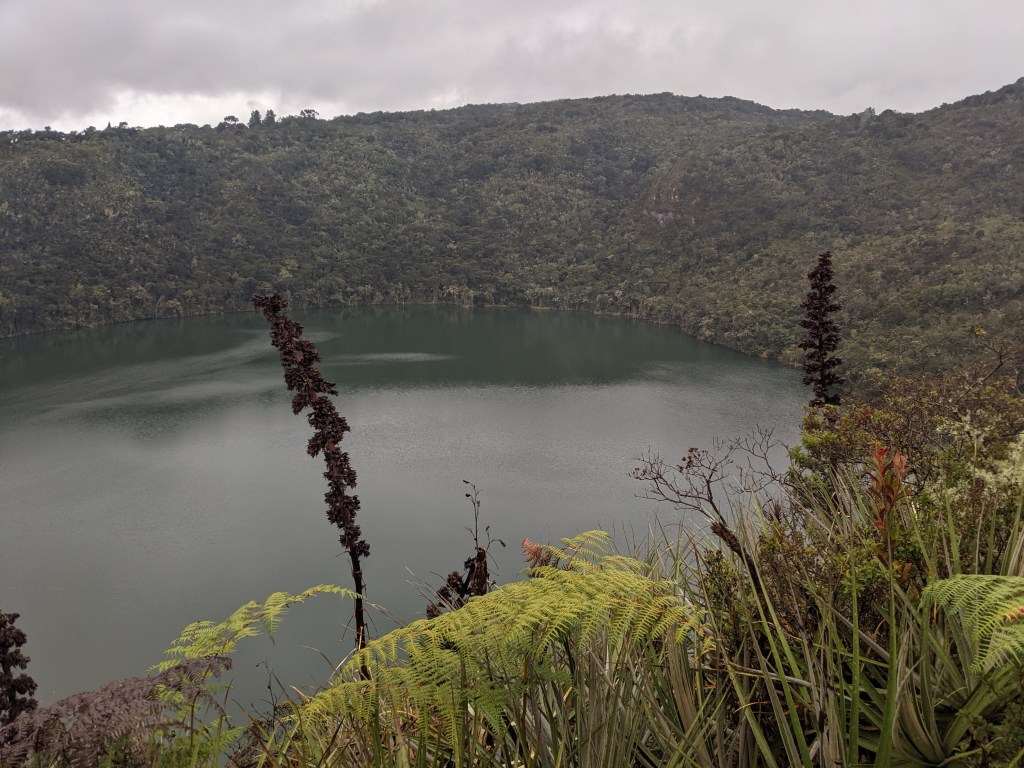
I was exactly that: mesmerised. Standing tall, I peered down into the crater below, unsure how the surface of the lake remained perfectly still in the lashing rain. Maybe there was something magical about this place, specifically chosen by the Muisca people for their rituals. I was forcibly removed from my daze once the others in the group had grown tired of my refusal to budge. They wanted to take selfies and pose in front of the barrier, not appreciate their trip into the hills. Elbows gently dug into my side as a woman tried in vain to push the hooded figure of me in my raincoat of out her next Instagram post, but I wasn’t moving anytime soon. Clearly, I was encroaching on their clout territory and they made disapproving mutters and tuts as I made it plainly obvious I wasn’t going to move one inch. Being tall and slightly imposing has a use sometimes. Eventually they gave up and moved to another viewpoint further along the ridge, but I followed them soon after. Bollocks to your selfies, my quest is more important.

Could Trevithick have drained the lake?
Had Trevithick ever made it to Bogota, he would have been so close to the lagoon he could feel it. The tingle of the ultimate treasure, the greatest fortune ever known that couldn’t be found. If he was stood where I was right now, he would have become distracted once more by a new project, one that so many had and tried failed to do over the course of hundreds of years. One equally impossible and brand new: draining the lagoon of Guatavita.
His engines could drain the chronically flooded mine shafts of Cerro de Pasco some 1500m higher than where I currently was, but could they drain an immense lagoon hundreds of metres in diameter? Could he then help himself to whatever lurked in the murky sediments deep beneath the surface? If ever there was a project to befit a man of such ridiculous optimism and mystical vision, it was this. But unfortunately, he never made it. Whatever he was heading to Bogota for was quickly forgotten at Guayaquil, when he learned of a brand new prospect: the recently discovered gold of the Costa Rican cordilleras. Out of the continent he went, onto the thin isthmus that wriggled up and out of the impassable Darien Gap. He would see Colombia eventually, arriving gaunt and bedraggled into the Caribbean port of Cartagena, staying there for a week or two in 1827 before somehow getting himself to Kingston and aboard a Packet ship destined for Falmouth.
I got back to my room after eating only to realise that Saturday night had arrived. The cheapest bed I found in this town was a hotel that also doubled up as the only club and my room was conveniently placed right off the dancefloor. The thud of reggaeton rattled my bedframe into the early hours and it felt immensely odd sauntering through in my dirty shorts and flip flops to the bathroom at the very end of the terrace whilst locals all dressed up looked on in confusion. Long before the night ended the music let off for a moment and I rejoiced, only to hear from another part of the complex the arrival of some kind of marching band, who played the same song over and over to an ever diminishing round of applause that was never enthusiastic to begin with. I was in for a long night.

 JOEL GRIFFETT
Leave a comment