Picking perhaps the most foul day of my month in London to do so, I ventured out and about across the capital following another Trevithick trail. Like any ambitious person, he moved to London to try and make it big, started countless projects that fizzled out and eventually went bankrupt and fell so ill he had to return to Cornwall.
Yet he undeniably left his mark on London and the surrounding area from Gower Street to the Science Museum, then from Westminster Abbey to The Bull Inn in Dartford. Westminster Abbey is the only one I skipped; it costs almost £30 to enter and I’m not doing that just to look at one stained glass window adorned with a steam engine and various Cornish saints.
The Science Museum

Rain lashed down across West London when I left the flat and foul gusts of wind played havoc with people’s umbrellas all day. My first stop was the closest: the Science Museum in Kensington. In the old biographies of Trevithick this was called South Kensington Museum and for a while I was confused when I couldn’t locate it, only to remember I’m an idiot.
The first of many displays in the Science Museum is the ‘Energy Hall’ which is essentially an homage to James Watt and his own work with steam engines. Of the eleven different information boards dotted across the room, most mentioned him, with only one for the work of Trevithick. I’m no engineer but a Trevithick engine is for some reason instantly recognisable owing to its compact design and I was astonished to learn that in keeping with Trevithick’s own throwaway approach to just about everything, the original engine that lies in the museum was found on a scrapheap and restored in 1882, 75 years after construction.
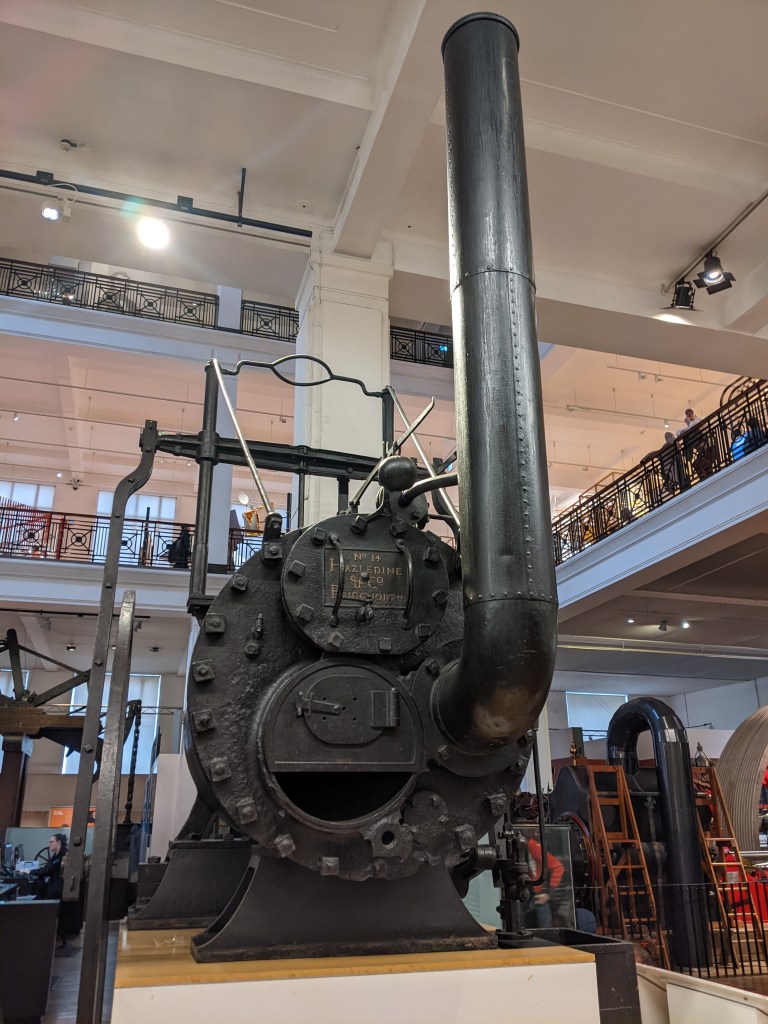

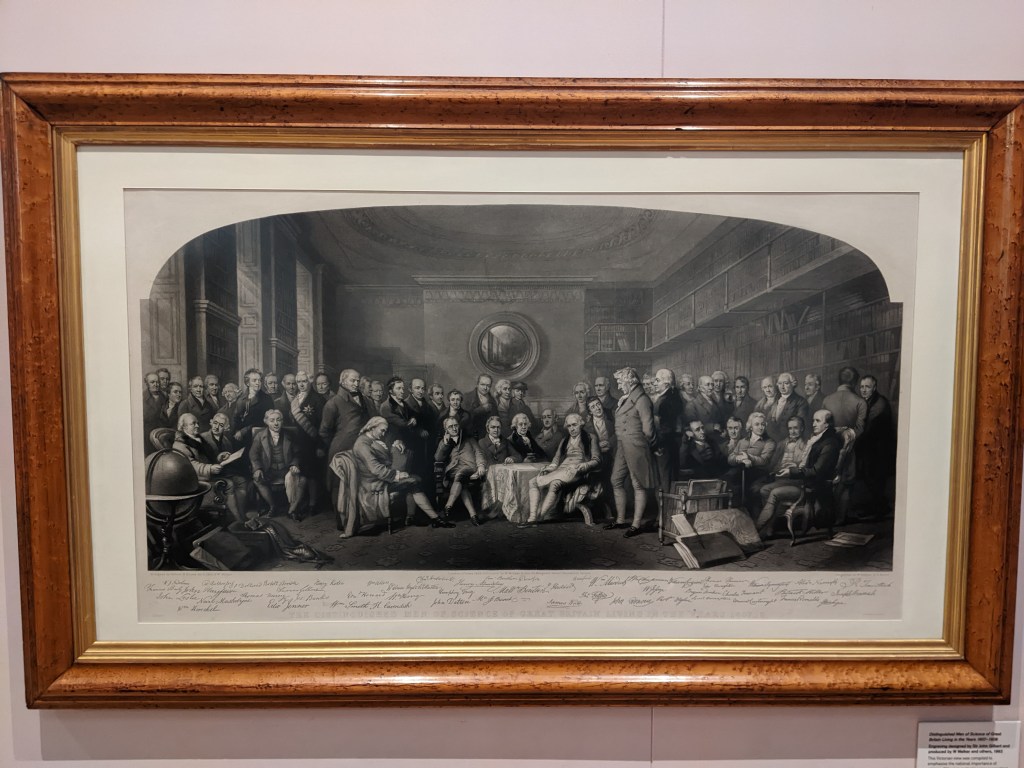
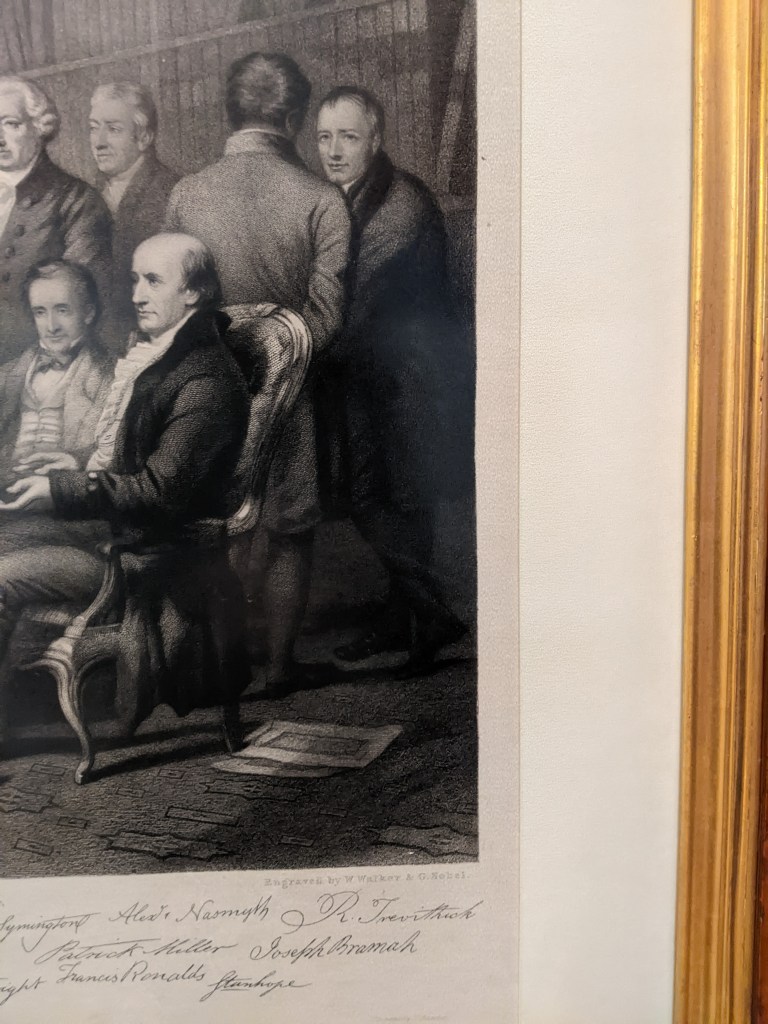
It is strange to see a whole homage to Watt, the man who called Trevithick evil for daring to wrestle with the dark arts of high pressure steam. Without that evil, the modern world wouldn’t be what it is today. I suspect he was a man of great ego because nestled away in the far left corner of the room was a portrait entitled ‘Distinguished Men of Science in Great Britain living in the years 1807-08’ in which all the great innovators of the time are gathered in one room, some sitting, some standing. Watt is centre stage looking both bored and smug. I scanned the faces looking for Trevithick. In the far-right corner I spotted the unmistakable nose of a very worried looking Cornishman, hidden away and muttering something to a man with his back turned. The signature all but confirmed his presence as a ‘Distinguished Man of Science’ but very much on the periphery of this illustrious group owing both to the year in which it was painted and generally how he is remembered as a kind of intermediary between Watt and Stephenson.
The foul weather made it feel like a museum day. The queue for the Natural History Museum across the road was quite the sight, a never-ending snake of people all hidden under hoods and huddled around the one person wise enough to bring an umbrella, stretching halfway back to South Kensington station. The Science Museum was equally rammed, with people who were taking a genuine interest in the exhibitions but also full of children who couldn’t care less about anything on display. I only came here for Trevithick but considering the visit was free I visited most of the other floors as well, before heading back out into the rain and my next stop.
Gower Street and ‘Catch Me Who Can’
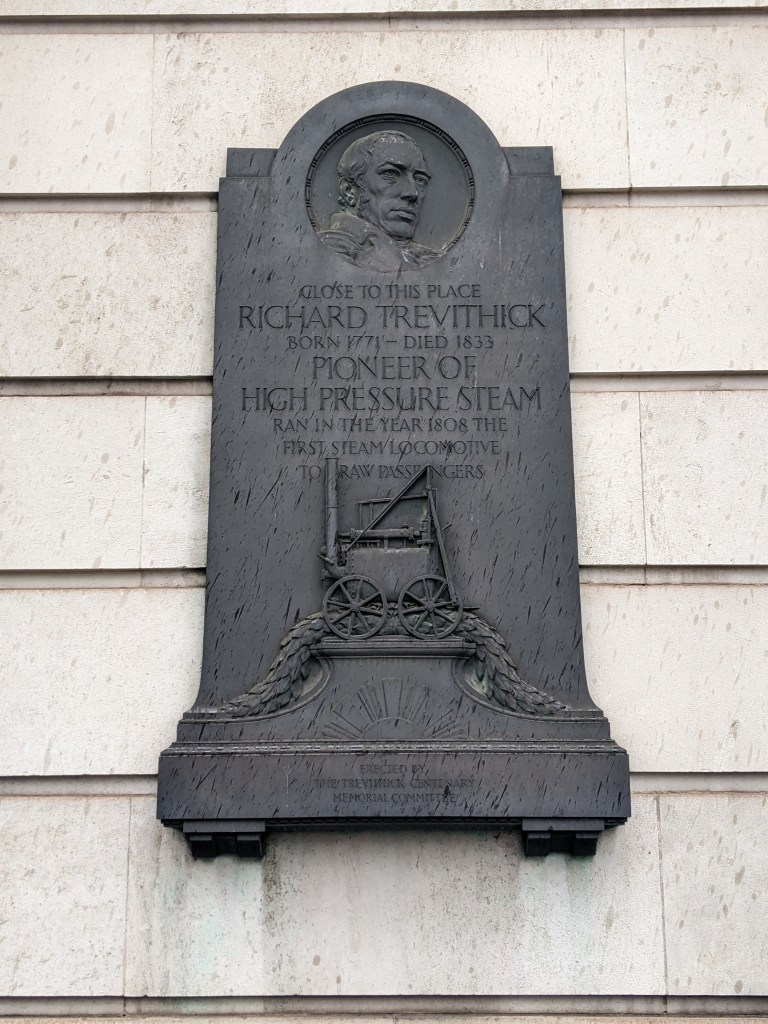
I took the tube to Leicester Square and instead of changing lines I walked the remaining twenty minutes to Gower Street. There lies a memorial plaque to Trevithick and his attempts at attracting punters to his ‘Catch Me Who Can’ steam carriage which ran on a circular track nearby. The response was less than enthusiastic and when it continued to fall off the rails the whole project shut down to prevent any casualties. ‘Catch Me Who Can’ was another example of the potential of this technology, reduced down to little more than a fairground ride. It was the first passenger locomotive in the world, but at a time when experts seemed to think such devilish methods of propulsion would cause people’s faces to rip clean off, maybe it was a waste of time. Use around mines across Britain would’ve been more appropriate, especially to be away from prying eyes. Perhaps Trevithick wished to share his innovations with the general public in the hope that they would be as enthusiastic as he, but alas, it did not work.
The rain eventually stopped but the cutting gusts of wind did not. I seethed my way to Gower Street, walking mostly in the road, out of the way of the ambling shoppers who walked at a pace just short of glacial. Arriving at the very bottom of the street I walked up, keeping my eyes peeled for this memorial. The whole of the street was dotted with blue plaques, acknowledging certain townhouses as the former residences of various notable figures, very few of whom I’d actually heard of. It wasn’t until I got almost to the very end of the street that I spotted the memorial, a hefty piece of stone far surpassing all the small blue plaques I’d walked past.
The whole street was dominated by University College London on one side and an endless row of small, understated but very plush hotels on the other. This and the countless private practices for all manner of different businesses made the smell of ganja feel very out of place, until I realised one of the grand old buildings had been converted into student halls.
The Bull Inn, Dartford
Charing Cross was within walking distance, so I continued my whistle stop tour of London on foot, silently cursing the slowly meandering shoppers. It didn’t matter how silent my curses were, they were written all over my face in the semi-permanent scowl that adorns my face whenever I venture into crowded urban environments.
From Charing Cross I took the train just beyond London to Dartford, a town in Kent and the place where Trevithick died. The Bull Inn is now known as the the Royal Victoria and Bull Hotel and I could think of nothing more symbolic than a pint or three of whatever Cornish ale they were bound to have on tap.
The wind was even more hideous in Dartford, which from the moment I left the train station, smacked me as a grim place. Various people had told me this is where dreams go to die and they might be right – it is a wretched looking town. In the late afternoon I entered the pub, beaming to see that they had Doom Bar on tap. My brief glimmer of hope was quickly crushed by the barmaid, who said they’d run out, meaning that I had to continue my newfound love affair with Guinness instead. She poured me the worst pint of the black stuff I’d ever seen and I found a nice corner in which to sit down and take out my notebook. When I rested my arms on the table it nearly collapsed, almost spilling the entire pint onto my legs before I’d even taken a sip. I sighed and moved to the next table.
While the bar was modern, the tables and chairs around the edges of the pub felt like they hadn’t changed since Trevithick stayed there. Many pubs have an ever so slightly morose edge to them, especially at around 5pm. There is never a shortage of men drinking alone and I always wonder how many pints they’d sunk and how long they’d been there. As I sat down alone too and started thinking about the death of Trevithick I realised I was one of them. How many of the other blokes here were thinking about death? Any future judgements about solo pubmen should be suspended.
Contrary to popular belief, this was the best place in town and may still be, as a 4-star hotel. Rumours circulate both home and away, and the idea that Trevithick died in miserable circumstances and was buried in a pauper’s grave isn’t right. I am admittedly quite hazy on many details of his life away from Latin America, so it took Philip Hosken to remind me of the actual circumstances of Trevithick’s passing. He was put up at the hotel at the expense of J&E Hall, an engineering firm working on early refrigeration technology, which I am told is steam in reverse. He sadly got pneumonia after no more than a year working in Dartford and died at the Bull Inn, buried in a respectable grave at the expense of his new friends in the town. It was undeniably a sad end far from home, but not quite as tragic as I thought before.
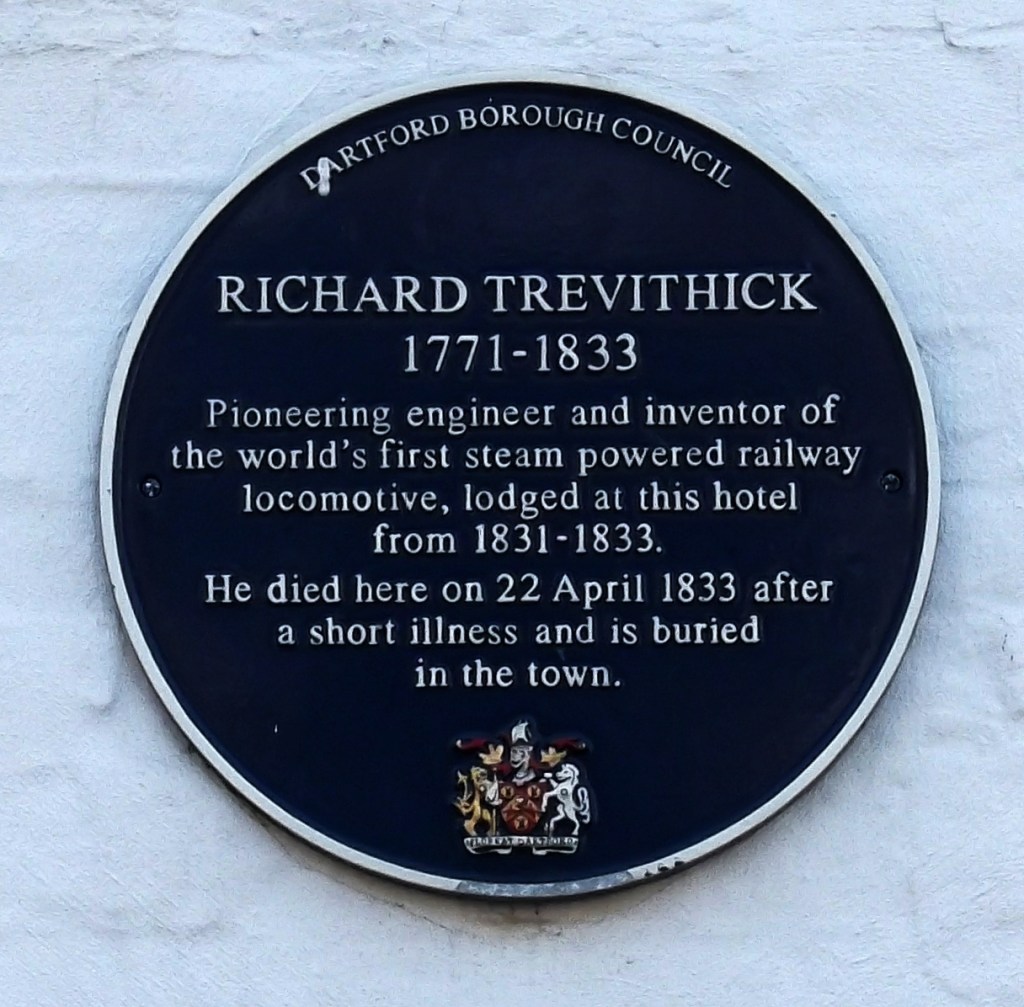
Various murals and plaques in Dartford honour Trevithick’s presence in Dartford and I went there with the best of intentions, but as I sat in the pub thinking about how strange it was that he died here, and wondering whether his spirit still lingered in the walls upstairs, I drank a pint too many for someone who hadn’t had any lunch and nearly missed my train back to London. I could’ve waited for the next one but I didn’t want to linger in Dartford any longer than necessary. Unfortunately this means I did not take any photos of the traces of Trevithick here, which in the modern world means I didn’t actually go. What was actually more important, however, was the fact that perhaps for the first time, he and I shared the same building, only 191 years apart.
Long Road to Nowhere: The Lost Years of Richard Trevithick (Part One) is available for pre-order now HERE.
 JOEL GRIFFETT
Leave a comment