Pre-order ‘Long Road to Nowhere: The Lost Years of Richard Trevithick (Part One)’ now, HERE.
I left Santiago in style. The Salon Cama buses here are luxury business class style seats that recline 140 degrees, spaced apart so well that you can recline the whole way without infuriating the person behind you (overly). Thank the lord that’s over; out of the frying pan, into a slightly smaller frying pan that smells just as bad. Valparaiso holds maybe 10% of the population of Santiago, although it’s hard to tell the difference.
I’m still glad to have left Santiago, not just because I dislike megacities, but also because the hostel was one of the strangest places I have ever stayed. The hostel itself was fine. I am not very picky; as long as I have a place to sleep, a place to write and a place to eat, I am satisfied. As long as those three places are relatively clean the rest is negotiable. I stay in hostels because they are cheap and also for the social element, but the hostel in Santiago had a worse vibe than the Queen’s funeral. Genuinely. I can overlook the fact that even the merest whisper echoed across the four floors; that the walls were made of cardboard meaning I could hear every car stereo and that same interminable reggaeton beat as if the speakers were in the room with me. But what I can’t overlook is how rude most of the other guests were. It was inevitably quiet, as you’d expect for low season, but to those actually in the hostel a simple ‘hola’ was met with blank stares, people ignoring me and a few times genuine bemusement as to why someone they didn’t know was saying hello to them. A week was more than enough and if I’d stayed any long I would have been enveloped by bitterness and rage (no change there then…)
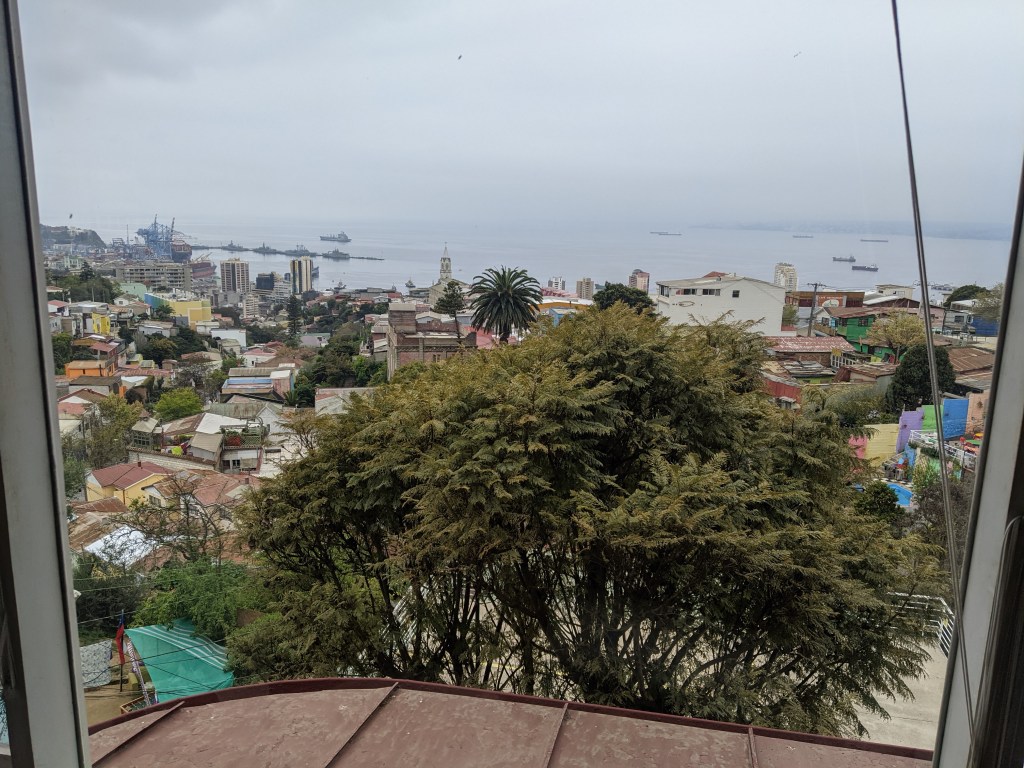
A little bit of Falmouth…a sprinkling of Penzance.
Valparaiso. Seagulls squawk overheard, pathetic in comparison to the Cornish ones who have grown up on a diet of chips and ice cream. Wind batters this port town relentlessly. Rickety tin fences and window frames with missing panes flap and batter in the breeze. Despite the dirty water and the dirty beaches there is the unmistakable hint of salt in the air. This is certainly a place a Cornishman would visit. The train tracks along the sea front remind me of Penzance; the large student population with their shit tattoos and neon hair remind me of Falmouth.
So here the trail begins, but honestly? There isn’t much I can tell you. All I’ve got to go off is this sentence from Francis Trevithick’s biography of his father:
The late Mr. Waters, an eminent Cornish miner, who for many years managed some of these mines in the neighbourhood of Valparaiso, said that Trevithick’s name was better known to the miners there than to the miners in Cornwall
That’s it: his name was perhaps venerated here. This is confusing because as far as I’m aware the nearest mines are not within the limits of Valparaiso itself. This is primarily a port town, the docks and it’s towering cranes dominate the coastline and the Chilean Navy are stationed here further along. Some might call me stupid for beginning the trail here, instead of around Copiapó much further north, at the edge of the mineral rich Atacama desert. This entire project feels stupid, considering how little information I’ve based it off. But I need not worry. I am a man and I will do what men do best: repress. Repress those feelings of doubt and charge forth into the unknown.
What irks me most about this sentence, mentioned in passing to try and explain one of his many disappearances from the historical record on his way from Peru to Costa Rica, is that at first sight it seems to be an irrelevant filler sentence to set up the next paragraph. But if you think about it, isn’t it odd to say that this Cornish icon and perhaps even national hero was more famous thousands of miles away on the other side of the world, than in Cornwall, where he spent most of his life and invented the steam engines he is well known for? Does this mean that Cornish miners were ignorant of Trevithick’s name? Surely not.
If ‘the late Mr. Waters’ refers to Sampson Waters, who set out for Chile in 1839/40 and returned home supremely rich 20 years later, then Valparaiso would certainly have been a stop along the way but not the final destination. The final destination for most Cornish miners would have been the port of Caldera, thence travelling the short distance inland to Copiapó or further into the Martian landscapes of the Atacama. Waters was predominantly involved with the Copiapó Mining Company, so it is possible that Trevithick’s name was better known there, not Valparaiso, as mentioned in the quote. In this nascent stage, I am simply creating my own rumours to drop onto the gently smouldering pile before me.
I already feel incredibly lost with this project. So many rumours, so many mysteries and a complete lack of concrete info, all in a country where Spanish seems to be an inadequate way of explaining the language Chilenos speak. To me at least, it is incomprehensible because they speak so unbelievably fast and much like the Andalucians, they have decided that the letter S is superfluous to the alphabet unless a word begins with it. My complete inability to comprehend anything anyone from Chile says has shattered my Spanish-speaking confidence, something I thought I was slowly beginning to get a grasp upon, leaving me at times paralysed by anxiousness. The best case scenario is when I understand them perfectly – ten seconds after they’ve spoken to me. By that point they’ve either switched to English to wandered off looking smug. Only one thing reassures me: apparently some native Spanish speakers can’t understand Chilenos either.
All the research in the world won’t help me understand these mysteries. Ironically this is stuff I could have done before I departed, but the magnitude of my undertaking only became apparent once I arrived in Valparaiso. I’ll be honest…I’ve got no idea what I’m doing. So in a way, this blog is as much a learning curve for me as it is for you, dear reader.
That being said, one thing did pop up. In my research I could find no explicit link between Trevithick and the mining industry in Valparaiso but his name began to pop up more when I latinised Richard to Ricardo. Suddenly there was far more information available to me, but none of it was related to mining. Instead it all centred around the ‘ferrocarriles’ or railroads of Chile and Ricardo Trevithick was routinely credited with inventing the first locomotive that revolutionised transport throughout Chile and facilitated the movement of huge quantities of silver and copper that left donkeys and human strength obsolete. In Britain, his invention is often overlooked in favour of the more powerful designs of George Stephenson that came some twenty years after Trevithick’s puffing devil. Unfortunately, like the mystic he was, he never got to see the fruits of his labour: the first railroads were not opened until the 1840s, by which point he had departed this life.
Tripping over tombs
Emboldened by this, I was feeling cheerful and decided to go for a walk. Naturally, there is nowhere more cheerful than a cemetery and this was my final destination for the afternoon. I knew there would undeniably be a Cornish presence into the Atacama, but I was intrigued to see if any Cornishmen and women had passed through Valparaiso and liked it so much they stayed (won’t be me).
It felt only right in a town that reminded me of Falmouth that I had to ascend Jacob’s Ladder on steroids and dodge the cascading rivers of piss to reach the entrance of the cemetery and I am ashamed to say the stairs left me wheezing in a way a young man shouldn’t. As I walked up to the grand marble archway and the tall iron gates that led inside I was waved away by a builder. Scaffolding covered the entrance and a man in paint splattered dangled from the top. He was staring at me. Everyone in Chile stares at me. Although the gate was ajar, the cemetery was clearly shut for repairs. I tried to ask if there was another way round but the man just waved his finger at me, as if to say ‘no pase, gringo.’
I followed the perimeter wall around and stumbled upon a second cemetery, guarded by the same grand archway. The gates here were locked, which was odd as I could see a few people’s heads bobbing amongst the tombs. A laminated sign was pinned to a wall just inside the gate: ‘entry by appointment only’ with a phone number beneath. That was not a conversation I was prepared for, I can’t understand anyone in person, let alone over a crackly phone line. Opposite the archway was another cemetery, one I hadn’t seen on the map: ‘Cementerio de Disidentes.’ This one was far more subdued and modest than the other two and luckily for me the gate was unlocked. As I slipped inside the gate the hinges squeaked and the noise echoed off the far wall. The groundsman evil eyed me for a moment but went back to digging. The place was near empty, but for a couple other gringos who were presumably German, given the prevalence of German names I could see before me. I got within earshot briefly and my suspicions were confirmed. There is something that makes Germans stand out. On my penultimate day in Santiago a group of four came into the common room to sort out their packs before departing. As I looked up from my book, one glance told me all four were German and soon enough, my guess proved itself right. Maybe it’s the boots, maybe it’s the marching in unison. Who knows?
After the first hour I had come across all manner of names – German, Scottish, English and Spanish of course – but no distinctly Cornish names as of yet. Inevitably some will get lost in the wider system of English surnames but when I spotted the first proper job surname just ahead the back of my neck began to tingle: there was a Cornish presence here. Rowe – 5 names, the last of whom passed in 1952. Slightly further on was a more grandiose tomb bearing the name ‘Pascoe del Rio.’ The engravings had faded so much that all I could make out was the last etching was 1994. As if by magic, more and more began to appear as I walked slowly and purposefully through the randomly arranged tombs and headstones, doing my best not to trip. All the while I was debating the moral implications of farting in a cemetery and worrying that if I did, it would be a loud one that echoed through the now silent compound. In total I found five more, not all graves had markings with dates or names, and some had been marred by the weather:
- William Bunster (of Falmouth) d. 2nd September 1893, aged 58
- Thomas Harvey Mitchell d.1932, aged 84.
- William Trevena, d. 4th June 1904, aged 56 & Arthur Trevena, d. 27th September 1960, aged 79
- Jory family (four names)
And one more I am unsure of (although the only two other times I’ve heard said name is a Cornishman and a Devonian rugby player)
- Captain J.C Moon, d. 9th July 1938
I was satisfied to find just one, so five or six more was fascinating, but it was as I’d expected, for none of the dates were even remotely close to Trevithick’s time in South America. If he did venture this far south after he left Peru one thing is for certain: he was, as always, so far ahead of the curve, blazing a trail for those who would venture here forty or fifty years later.
The timing was perfect. Just after I found the Trevena tomb another groundsman appeared out of thin air pointing at his watch, politely telling me to piss off, ‘afuera’ he said gruffly. He told me to come back tomorrow and slapped me heartily on the back as I walked off, perhaps to let me known he wasn’t being rude, just blunt.
As I walked towards the gate I farted again. Looking around to make sure I was safe, I came face to face with a headless angel with it’s arms held out, as if beckoning me into the beyond…
If you liked this article please share it around and if you want to read more, make sure to follow the blog so you’ll get an email every time I post. Cheers n gone.


 JOEL GRIFFETT
Leave a reply to Joel Griffett Cancel reply