Pre-order ‘Long Road to Nowhere: The Lost Years of Richard Trevithick (Part One)’ now, HERE.
Walking back into town late on Saturday afternoon I spotted the anchor as two buildings parted and the ominous Martian hills came into view once more. I had read about the anchor before, mentioned in passing in the late Michael Jacobs’ ‘Ghost Train Through The Andes’ a book, in hindsight, I should have brought with me given how my journey through Chile has essentially become a trainspotter’s wet dream. Jacobs’ traces his grandfather’s trail through Chile and Bolivia during the nitrate boom and in the modern day manages to cadge many rides on the cargo line that heads deep into La Pampa, beginning in Antofagasta and finishing up in Oruro, Bolivia. If I return to Chile I will do something similar, but since I’m a degenerate, it’s more likely to be train hopping than riding up front in those filthy diesel locomotives.
But hindsight is a wonderful thing; I could have turned my Chilean zigzag into a desert tour of all the remote and abandoned places left behind when the railroads became obsolete. I certainly dabbled with that but I’d definitely need a tent and supplies because some of these old stations are way out in the middle of nowhere, dangerous places to rest your head overnight.
Hindsight is a wonderful thing; I should have taken a slightly larger backpack with me. Even after leaving clothes and other belongings behind as I go my pack is bursting at the seams – a collection of hefty books I have yet to touch weighing me down. Bringing the one-thousand and one page Arabian Nights might have been a miscalculation, but I digress.
Nelson’s dodgy foot meant ascending the steep hill with me was a no go and while we went for lunch at a hole in the wall Peruvian eatery he successfully filled me with dread before I’d even put my hiking boots on. He pointed towards the colourful but bedraggled homes that crept up the slope, a mass of ramshackle buildings, crumbling walls and corrugated rooves and described them as the favelas of Antofagasta. I couldn’t help but smirk. Obviously I would take care but I felt he was being a tad dramatic.
He sighed at the complacent foreigner, ‘just don’t take anything valuable with you,’
‘I won’t,’ I assured him, ‘I’ll leave my wallet behind,’
‘What about your phone?’
‘No one wants this phone, seriously,’
Seriously. This is the worst phone I’ve ever owned and ironically the most expensive. I reluctantly broke the £100 barrier when purchasing it in the summer and I did not pay for quality. The phone works great, but the battery does not. More than ever out here, I need a reliable phone but it has died at full battery on more than a few occasions, the worst when I was wandering about in the endless sprawl of Santiago in September. If I don’t ever touch it, not even to check notifications, the battery might last a day. But that isn’t possible, especially when I get lost every 5 minutes.
Any potential robber hidden round a blind corner in the hood would be more annoyed if he dispossessed me of my phone than if I’d ran off with it. He would immediately realise it is a piece of shit and be half tempted to return it to me somehow out of pity. Maybe he’d misjudged gringos, maybe they’re not rich after all. He feels the outline of his own phone in his pocket and takes a peaceful breath. Maybe my life isn’t so bad after all; I already have a nicer phone than this lanky gringo. A peculiar Israeli I’d met much further south who sounded exactly like Adam Sandler in ‘Don’t Mess With The Zohan’ had teased me for not having an iPhone; he was certain only people in third world countries had Androids, so maybe no one was interested in it regardless.
The Upside Down Anchor

Nelson didn’t look convinced by my potential naivety, but since the excessive portion of Lomo Saltado sent me into a coma I had a couple of hours to reconsider. In that time I managed to overthink it massively and left everything behind, which meant I had to wait outside Nelson’s house for half an hour after I returned because he hadn’t heard me knocking on the door with increasing fury. I walked through the ‘favela’ without mishap, mainly because it was a Sunday afternoon – the worst time to do anything at all and rued the fact I didn’t bring my phone. I needed to take some pictures.
‘Ten cuidado,’ said Nelson as I left. Here I was thinking he meant watch your back in the hood, but really what I think he meant was, don’t fall down the hill. The slope was infinitely more perilous than the neighbourhoods I had to walk through; a path as steep and slippy as the volcano in Pucón looked down on me. My trusty boots were getting a real test in the desert and they were holding up well, but a lot of my ascent was one wrong foot away from falling down another mountain.
Once I reached the top I saw that the anchor was not painted as it seemed from sea level, but it was set in concrete. Paint wouldn’t last over 150 years, not in a battle against salty sea winds and the Martian dust blowing in all directions. I thought that the upside down anchor was just another whimsical thing about Chile; another aspect of this country that I didn’t understand, but when I looked into the Spanish sources I found there was a mix up when Hicks passed the information onto the man responsible for the design.
Now, I don’t know how this exchange went, but there are two options of how ‘don’t paint it upside down’ was lost in translation. The first is that George Hicks’ Spanish was so atrocious (his thick accent probably wouldn’t help) that he somehow uttered the phrase ‘al reves’ (upside down) or the like when trying to make sure it went off without a hitch. The alternative is that the man, Claveria, was a simpleton and this is the most likely explanation. Allegedly, he’d never seen an anchor in real life and never bothered to ask someone to show him one before he was tasked with the creation of one that would stay carved into the landscape for eternity. Why Hicks chose this man is beyond me.
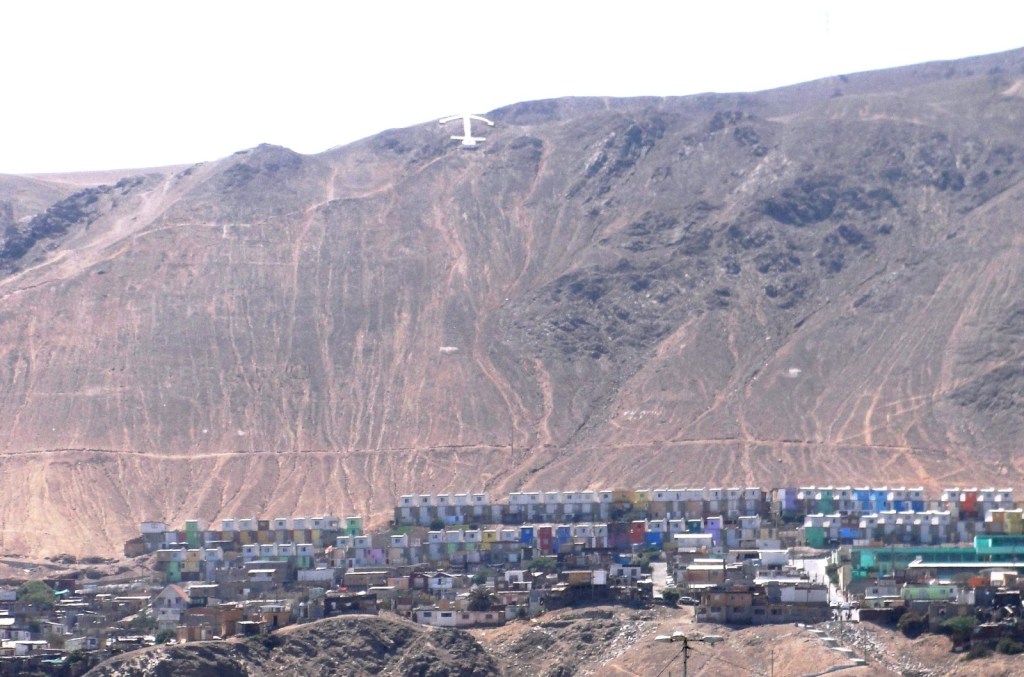
Given that Hicks was the manager of CSFA for a long time, one hopes his Spanish wasn’t appalling and that the misunderstanding was the fault of Claveria. Either way, the anchor remains, visible from the town and out to sea and regardless of it’s orientation, most ships make it safely into the port to load or unload cargo without crashing into the promenade that runs along the seafront. After standing at the top and staring at the city below, I chose another less perilous way down, all the while thinking how on earth they managed to construct the anchor on such a slope over 150 years ago.
***
On Monday morning, the working world began to awake once more. Not the museums of course, they were all still shut today. Nelson found my bad timing immensely funny, almost as funny as my appreciation of Limon Soda. The calls he made on Friday afternoon when we first met in Plaza Colon weren’t completely fruitless. A friend of his, a historian, had some information to offer. If not that, his time. Nelson surprised me with this information on Sunday night and told me to be up early in the morning. I wasn’t. By the time I was awake, I was starving and instead of preparing myself for the meeting, all I could think of was empanadas.
We passed through security gates and I watched the woman in the hut have a meltdown trying to process my surname. For some reason, no one so far in Chile could pronounce it without severe difficulty and she was no different. I dictated it to her, spelling it wrong as I always do because I confuse E and I every single time. We ascended metal stairs and were accosted by a secretary, who took an absurdly long time to let this mysteriously unnamed friend of Nelson know we had arrived.
As we sat down in his office, I felt completely out of my depth for the first time. The language struggles are part and parcel of any traveller’s journey but this…this was something altogether different. Here I was expected to explain myself and my motives in front of not one but two local historians. Nelson explained the basics but owing to my lack of ability I hadn’t conveyed to him that I wasn’t writing a book solely about miners and mining. Nor had he grasped that I was writing about my own experiences and the contemporary atmosphere of the places I visit, not just some academic work. I didn’t want to disrespect the historians, who were obviously interested in this, nor did I wish to disrespect their city, which is built upon the mining trade and wouldn’t exist as it did today without it. Nelson did his best to emphasise, as he always did, that if they spoke slowly I could understand. They obliged at first, but that went out of the window within minutes, that impenetrable Chilean accent doing it’s best to confuse me once more.
Nelson turned to me and explained the finer points in his ‘foreigner voice’ much to the amusement of his friend Patricio,
‘why are you speaking like a Gringo Nelson?,’ he teased.
‘He speaks Spanish, not Chileno,’ he rebutted.
‘Pah,’ Patricio replied dismissively. Another Chileno not aware of their own accent perhaps?
Nonetheless, they were helpful. They pointed me in the direction of some useful sources and gave me a small notebook and a pen as a gift, which would have been a generous gesture had the pen worked or if the pages of the notebook were actually bound together, instead of peeling off when I turned each page.
Patricio and Hector were well acquainted with the name George Hicks, nodding approvingly when I mentioned him. I was almost taken aback given that usually these obscure names were met with blank faces and shrugs, but Hicks left a lasting legacy on the city of Antofagasta, both historically due to his minor but visible part in the outbreak of war and materially thanks to his orders to first paint then construct a hefty upside down anchor on the hill overlooking the port. Had Trevithick persisted and stayed in one place, not fleeing when he tripped over the first few hurdles, his name would still be known, most likely in Peru or in Costa Rica where he spent the most time. Instead, he swatted about like the deranged moth that found its way into my room last night. The most fearless coward there ever was. Completely unafraid of delving headfirst into the unknown, the hardest and most impressive part, but as soon as his head hit the bottom he swam straight back up, jumped out and found a new pool of water in which to do the exact same thing again.
***
After two weeks of hopping, hitching and hiking around the desert speaking nothing but Spanish with inconsistent results, I was drained. Mostly from the language. I don’t know enough Spanish to be speaking it so frequently and more often than not when I try and say anything that isn’t a short sentence or a question I start scrambling desperately for words I don’t know. By the time I left Nelson’s house I was drained. I just wanted to speak English. I wanted curry and a fry up at the same time, but both of those were a long way away.
If you enjoyed this article you know what to do – like, share, comment, follow. Please and thanks

 JOEL GRIFFETT
Leave a reply to philip@htpbook.co.uk Cancel reply