Having sold all the copies of my first book Long Road to Nowhere it feels only right to reflect on it now, over eighteen months after it was published.
With the joy of hindsight, it was probably not the best style of book to begin with, given the subject matter and the target audience. If I were to draw a Venn diagram with ‘those interested in Trevithick’ on one side and ‘fans of writers like Hunter S. Thompson who see his obvious influence on my writing style’ on the other, those in the middle number very few beyond me and a handful of friends.
The subject matter and my style of writing have rarely been combined before. While I received positive feedback about my writing style and the book as a standalone travelogue, I am aware that many feel short-changed as Trevithick essentially does not appear at all. If you read the blurb that would be obvious, but considering the subtitle was ‘The Lost Years of Richard Trevithick’ I was admittedly throwing out wildly inconsistent messages.
To publish a travelogue completely unrelated to the subject matter I had been investigating was a semi-accidental statement of intent that I planned to build upon. Whatever I thought was coming next after that book was always going to be immensely more refined than that rough and ready travelogue. Again with hindsight, a book like that would have made more sense as a postscript or epilogue once I had finished grappling with as many of the historical mysteries I could find.
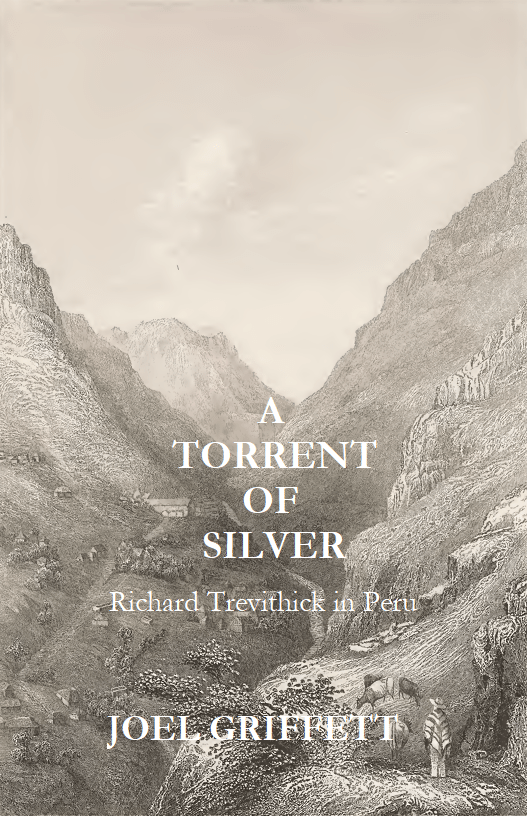
In the last year at least, I have taken a step back from writing first person travelogues and gone full throttle as a historian. Last month I submitted a 40,000-word MRes thesis to the University of Exeter entitled A Torrent of Silver: Richard Trevithick in Peru, a long overdue work of history that I should have led with instead of a travelogue.
A Torrent of Silver covers Trevithick and the contribution of other Cornishmen to Peru as miners, engineers, prospectors and smelters based mostly off Peruvian archival sources (now dispersed between Spain, Peru and the USA). It is currently awaiting examination and once I receive a verdict in the coming months I can decide how to disseminate it to the expectant audience who read the first book in the hope of actually learning something useful. I would like to self-publish and sell it direct from my website again, but I am not sure if this interferes with my next steps.
I am continuing down this academic path, frantically applying for PhD funding for my full-length thesis with the working title On the Avocado Mountain: Richard Trevithick in Costa Rica, a nod to the Monte del Aguacate (translates literally as Avocado Mountain) where Trevithick worked the gold mines from 1824-1827. This will also cover all the loose ends from the end of his time in Peru in 1823 and his route up the Pacific that eventually ended in Costa Rica.
***
At the tail end of last year I took a break from thesis writing and revisited the travelogues I had written for Peru, first in early 2023 and again in 2024. Those words had remained largely untouched, taken from my notebooks and typed up into a Word document. This was, so I thought, the foundation of the next instalment of Long Road to Nowhere in the same style as the first but more focused on Trevithick and more informative, as I was in Peru and actually on his trail.
The gap between the two styles is enormous and it took me a while to really find my voice writing pure history. I only became aware of the fact I’d found that style when I began to re-read the travelogues. Reading through those pages for the first time in years, it felt like a lifetime had passed and I struggled to contain my contempt for the way I had been approaching the project.
Since returning from my second trip to Peru in March 2024 (the first time I actually went to an archive in Lima, not just a library) I have slowly transformed into a historian, a title I was always hesitant to use when describing myself, preferring the vague and more mysterious term ‘writer’ instead.
Last year especially marked an irreversible shift in my approach to this project, away from a first person style into narrative history. A fully funded research trip to Indiana University and a partly funded one to San Jose to continue my research in the National Archive were the achievements that really confirmed the shift.
Given the extent of the information available on Trevithick in Latin American archives, it would be wrong to continue to centre myself in this story. While I now see myself as a historian primarily, I cannot abandon the travelogues completely and they will still form an integral part of all my work (just not with the University!). My travels across the Americas go further than the archives and libraries of Lima and San Jose and part of the story is of course my own search.
For me personally, writing first-person travelogues is a form of catharsis unmatched by anything, except maybe intense cardio. The peace of mind I achieve after filling another notebook with my adventures and then later streamlining it into a word document is not a feeling I get when writing pure history.
Part of the reason I feel contempt for the Peruvian travelogues is because there was little development from Long Road to Nowhere, as my first visit to Peru was a continuation of the same long journey that started in Chile and Bolivia. I was frankly a lost young man still coming to terms with the ridiculous plan I had given myself and the immaturity of what I was writing then reflects that.
In comparison, when I finally wrote up the pages from the notebook I took with me to Costa Rica last year the outcome was much more positive. The progression is evident from previous excerpts as little more than a tourist, wandering around alone quite lost and unsure of when, if ever, I’d find anything substantial.
Costa Rica was a proper adventure, organised beforehand with local guides who led us to many of the abandoned gold mines that Trevithick once worked. The icing on the cake was of course discovering ‘Don Ricardo’ mine, claimed by Trevithick in 1825 and named in his honour decades later (more on this soon).
That week spent semi-delirious in the humid Avocado Mountain searching for abandoned gold mines was an unforgettable experience and is thus worthy of inclusion. An entire book containing little more than the day-to-day ramblings and idle wanderings of a cynic might be hard to swallow, but in shorter bursts they offer something extra that history cannot.
But fear not, not all the travelogues I wrote in Peru are terrible – I will begin to share a few of the more interesting excerpts in due course.
***
It took me far too long to write this and I hope I have conveyed my thoughts correctly. These are long overdue reflections on a project that has evolved a lot since it began.
To everyone who read the first book and was disappointed, please forgive me, I promise that what comes next is the history you thought you were going to get last time.
I started this project with a one-way plane ticket to Chile in September 2022 and now I am looking at a fully funded PhD commencing later this year. To say I had absolutely no idea what I was doing in the beginning is an understatement.
That rudderless ship has since been put back on course and I will still get a trilogy out of Trevithick in Latin America, only much different (better) than I ever expected.


 JOEL GRIFFETT
Leave a reply to Josh Cancel reply