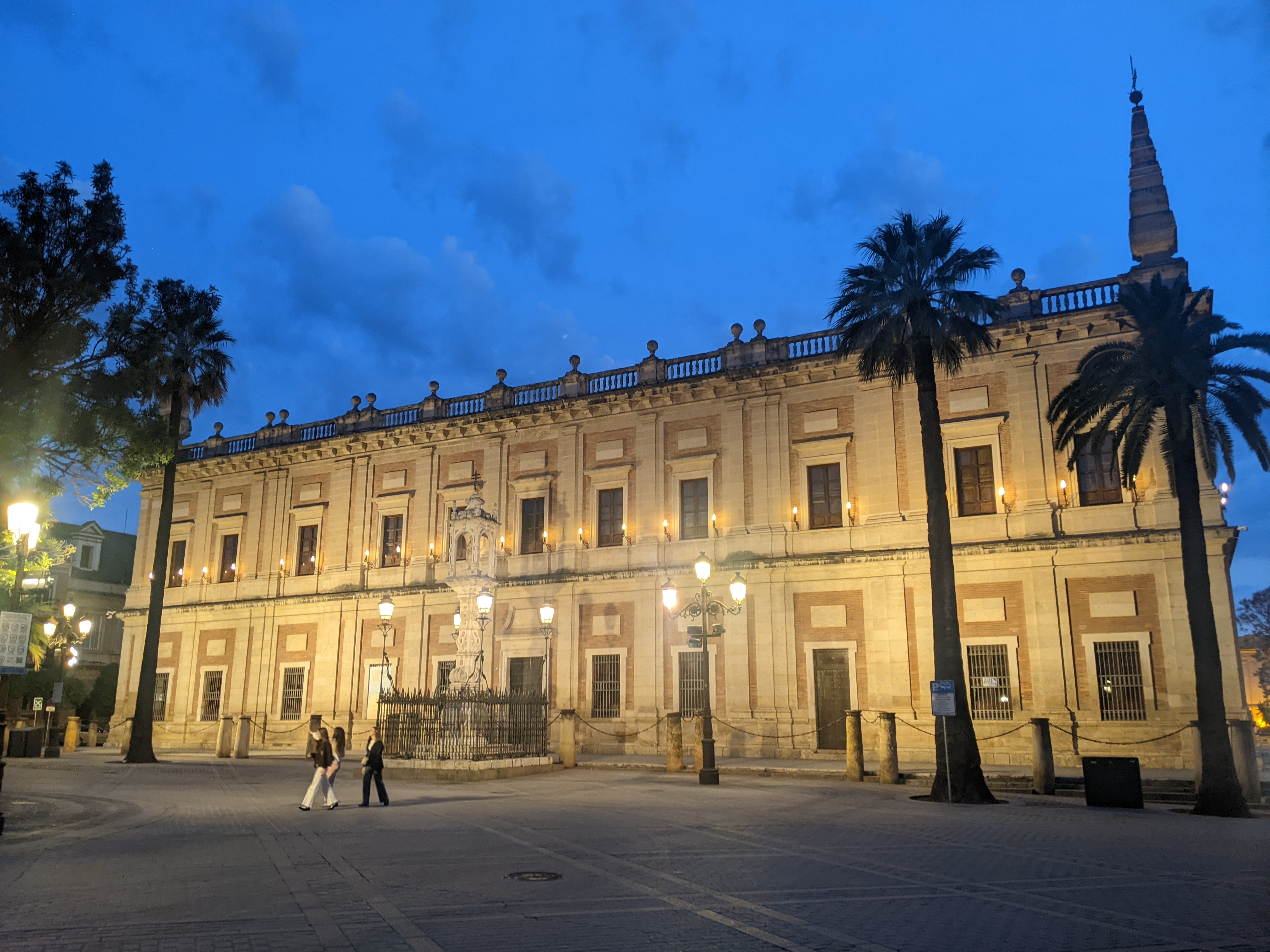
In May I visited Seville / Sevilla for another research trip to the Archivo General de Indias, the old Spanish colonial archive. It was right in the middle of the old town (casco antiguo) and I had unknowingly walked past it on my previous two holidays in Andalucia.
By accident I took the slow bus to Seville and embarked on a tour of various small towns along the way from Malaga. A journey of two hours took four, through pristine and whitewashed, but always strangely empty Andalusian towns, their charm perhaps dimmed by dark and threatening clouds above.
I arrived into Plaza de Armas bus station for the first time, but to Seville itself for the third. My first two trips here were late-October sojourns from Cornwall, when the city was still basking in very late summer sun. Both times I had circled the grand old building that was once the Casa de Contratacion, now known to tourists as the Archivo General de Indias. I had walked past the modern archive itself. Both times I had never paid any attention to the prospect of all the material contained within.
Ironically, it was too late to include any of the research here in my thesis, which I resubmitted days before I flew to Malaga.

Arrival at the archive
Leaving my lodgings the next morning, I made a fool of myself within twenty minutes, which is a record even by my own high standards. I circled the grand building once more (now as a historian) and entered through a security scanner into the building itself, rather sparsely decorated within.
I realised only now that I hadn’t actually checked if the archive was inside the old palace. It was not. Less than a minute after passing through the scanner I asked the guard and he told me the archive was across the street. The modern archive is a nondescript government building obscured by low-hanging trees. Another security scanner and rows of lockers in a bare white reception. I gave the man behind the desk my name and he handed me a sheet of instructions as it was my first time here.
Much like the National Archive of Costa Rica, I could not bring a notebook into the reading room. I had no paper, but a pile of loose A5 pages was placed on the main desk. As in San Jose, I did not question this strange rule, and instead was grateful that the paper they provided was not a pile of irregularly shaped waste paper discarded by the staff.
The reading room was on the first floor. I sat down and finally understood why I was given a username and password before I arrived – I had to make a request for material on the computer in front of me. Almost an hour after I sat down, frantically updating the ‘request status’ tab on the screen, the documents were finally ready and I went to collect them.
A man retrieved an enormous tome ‘Lima,1358’ and slammed it on the desk in front of me. He smirked at my remark at the size of the folder. It was wrapped up and secured like an Egyptian tomb and once I had removed the outer layers and the strings holding it all in place I now had access to about 3000 pages of Peruvian mining records dating from 1813 to 1831.


IN SEARCH OF THE LOST SILVER-COPPER MINE
This research trip to Seville had been in my mind for a long time. Somewhere in this enormous slab of paper might be one reference to the lost silver-copper mine of Cajatambo that Trevithick had tried to take ownership of in the very final days of Viceregal control. From the records I had uncovered in Peru, I knew he left Cerro de Pasco in in late February 1818 and by November 1819 said request had been denied. As per Spanish mining law, foreigners, particularly heretical Protestants, were not allowed to own mines. Any documents relating to the mine in that period did not exist in either Peru or the USA. If any of the records had survived, my hunch was that they were within this enormous stack.
By the end of the day I had to accept my hunch was wrong. There was no mention of a copper mine, nor any mine in or around Cajatambo. Relating to this particular search only one document was useful, further confirming Trevithick’s departure from Cerro de Pasco and his prospecting mission across Peru.
Days before Trevithick disappeared for 18 months, Juan de Oyarzabal and ‘an Englishman who recently brought steam engines to Callao’ were to depart on a mission to rehabilitate any currently abandoned mining works. Juan de Oyarzabal was the superintendent of the Royal Mint at this time and thus met Trevithick on his arrival to Lima the previous February. Oyarzabal died on the 21 May 1818, just over three months after writing this letter. One would hope Trevithick had no involvement in his demise, although this theme continued through his time in Peru…
Many, many hours after I entered, I tried and failed to repackage the tome in front of me. Words in any language were beyond my capability after going through thousands of pages and instead I communicated in nods and grunts with the kind woman who collected the volume back from me. I left the archive completely fried, both from the mental exertion and from sheer confusion. I was convinced that I would find at least one reference to the lost Cajatambo mine in those records and again it was absent. Nevertheless, my research trip to Seville was not over. I still had a couple more days booked into the reading room and another set of documents to look through tomorrow, but 1358 was the only volume directly related to mining.
I perched on a ledge in the shady side of the Casa de Contratacion until my brain unclouded, then walked towards my lodgings, stopping to buy a sandwich and several beers on the way. When I arrived back at the roof terrace I wasn’t quite so frazzled, but the prospect of returning to the archive again tomorrow was deflating. My search for Trevithick in Peru had taken me there twice, to the USA and now to Spain and I knew it was coming to an end, just not a logical one.
The lost mine was still a loose end, one that had bothered me for so long. Not a single reference to Trevithick and the mine survived and it made no sense.
Part two of my research trip to Seville coming soon.


Leave a Reply